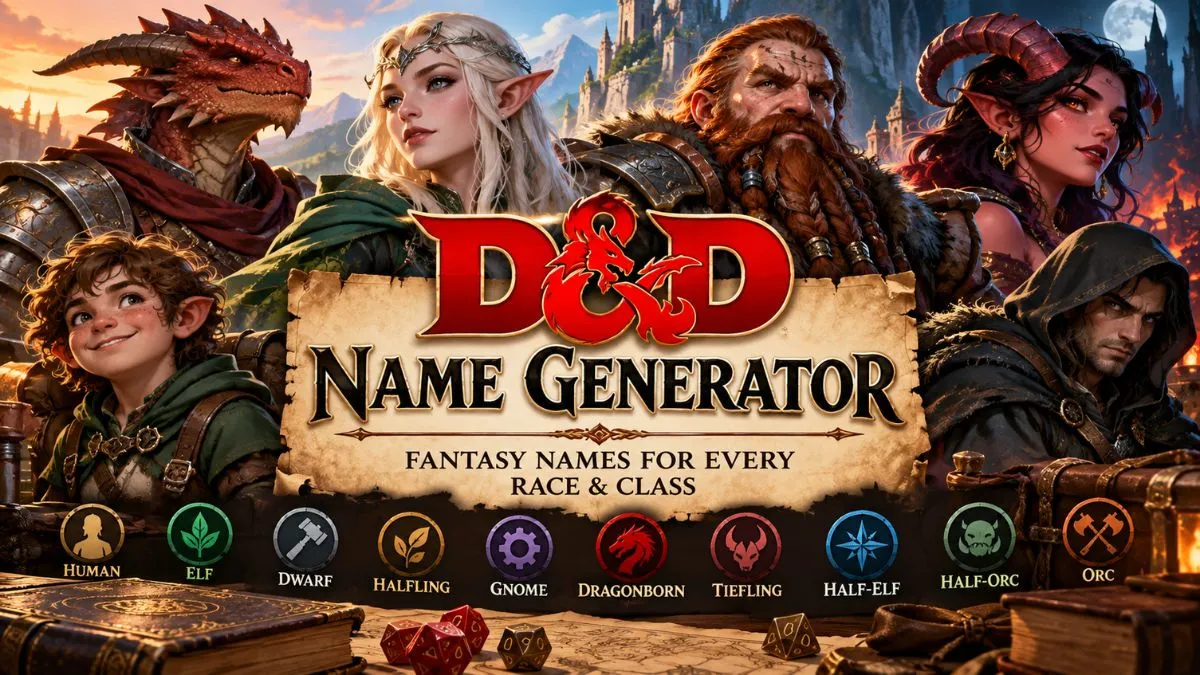
D&D Name Generator – Fantasy Names for Every Race & Class
Creating a memorable D&D character starts with a name that feels like it belongs in the world. A graceful elf, battle-hardened dwarf, mysterious tiefling, and proud dragonborn shouldn’t all sound as though they came from the same naming list.
Use our D&D Name Generator to create fantasy names based on your character’s race, gender, class, and preferred style. Generate one name for a new player character or create an entire batch when you need NPCs for your next campaign.
D&D Name Generator
Generate fantasy character names for humans, elves, dwarves, halflings, gnomes, dragonborn, tieflings, half-elves, half-orcs and orcs.
⭐ Saved Names
Quick Checklist
✅ Generate: D&D first names, full names, surnames & clan-style names
✅ Races: Human, Elf, Dwarf, Halfling, Gnome, Dragonborn, Tiefling, Half-Elf, Half-Orc & Orc
✅ Gender: Male, female, gender-neutral or any
✅ Classes: Barbarian, Bard, Cleric, Druid, Fighter, Monk, Paladin, Ranger, Rogue, Sorcerer, Warlock, Wizard & Artificer
✅ Tieflings: Infernal-style and virtue-name options
✅ NPCs: Quickly generate names for unexpected characters
✅ Quantity: Generate one name or a larger batch
✅ Favorites: Save promising character names
✅ Copy: Copy individual names or the complete list
✅ Best approach: Let race shape the core naming style while class adds character flavor
How to Use the D&D Name Generator?
You don’t need to build an entire character before finding a name. Start with the details you already know and let the generator narrow the possibilities.
1. Choose Your Character’s Race
Race or species has the strongest influence on the naming style.
Select from options such as:
- Human
- Elf
- Dwarf
- Halfling
- Gnome
- Dragonborn
- Tiefling
- Half-Elf
- Half-Orc
- Orc
Each category uses its own naming patterns rather than simply generating the same fantasy names under different labels.
2. Select a Gender
Choose Male, Female, Gender-Neutral, or Any.
Gender-neutral is useful when your character doesn’t need a gender-specific naming style, while Any gives you the broadest mixture of results.
3. Choose a Class
You can optionally select your character’s class.
A class shouldn’t completely replace the naming conventions associated with the character’s people or culture. Instead, it can add flavor.
A dwarven wizard, for example, should still sound plausibly dwarven, while a dwarven barbarian can use the same underlying style with a tougher epithet or surname.
4. Choose a Style
Where available, use style controls to make results more specific.
A tiefling might use an infernal-style personal name or a virtue name, while a human could use a traditional fantasy, medieval, noble, or rugged naming style.
5. Select the Number of Names
Generate one name when you need a quick answer or create a batch when you’re brainstorming.
A list of 10 or 25 names is especially useful for Dungeon Masters who want spare NPC names before a session begins.
6. Generate Your D&D Names
Press Generate Names and review the results.
Save the names you like, copy individual choices, or regenerate until one fits your character.
You may also be interested in : Random Name Generator – Generate Male, Female & Full Names
What Makes a Good D&D Name?
A good D&D name does more than sound unusual.
It should fit the character.
Consider a few basic questions:
Who are they?
An elf raised among elves may need a different naming style from a half-elf raised in a human city.
Where are they from?
Two humans from distant kingdoms don’t necessarily need similar names.
What is their personality?
A cheerful halfling baker and intimidating half-orc mercenary can benefit from very different sounds.
Will everyone at the table remember it?
A complicated fantasy name may look impressive on a character sheet but become frustrating if nobody can pronounce it.
Does it sound too similar to another character?
Avoid filling a party with names such as Vaelor, Vaelen, Vaelis, and Vaeron unless that similarity is intentional.
The best name is usually distinctive without becoming distracting.
D&D Names by Race
Different D&D peoples have different naming traditions and fantasy associations. The generator uses these differences to create more varied results.
Human Name Generator
Humans offer the greatest naming flexibility because human cultures in fantasy settings can vary enormously.
A human might have a simple village name, aristocratic family name, rugged northern name, or something influenced by an entirely fictional culture.
Examples:
Aldric Fenwick (Human – sturdy medieval-fantasy style)
Elara Vayne (Human – elegant fantasy style)
Garrick Thorn (Human – rugged adventurer style)
Mira Ashford (Human – versatile fantasy full name)
Cedric Vale (Human – traditional heroic style)
Lyra Hartwell (Human – softer fantasy style)
Human names work particularly well for fighters, paladins, rogues, wizards, clerics, and other characters whose identity isn’t tied to a strongly nonhuman naming tradition.
Elf Name Generator
Elven names often work best when they sound fluid, elegant, or melodic.
Rather than making every elf name excessively long, a good generator should create names that remain usable at the table.
Examples:
Aelar Moonwhisper (Elf – flowing fantasy style)
Sylara Dawnleaf (Elf – nature-inspired family style)
Theren Starbough (Elf – celestial and woodland flavor)
Vaelis Silvergrove (Elf – elegant fantasy construction)
Lethira Nightbloom (Elf – mysterious nature style)
Eryndor Sunweave (Elf – bright, melodic style)
Nature, stars, forests, moonlight, ancient magic, and elegant sounds can provide useful inspiration without pretending invented names have literal historical meanings.
Dwarf Name Generator
Dwarven names generally benefit from stronger sounds and memorable family or clan names.
Examples:
Bromli Ironhand (Dwarf – strong clan-style surname)
Dagna Stonevein (Dwarf – mountain-inspired family style)
Thordin Emberforge (Dwarf – forge-inspired construction)
Brynja Deepdelver (Dwarf – underground adventurer style)
Korin Bronzehelm (Dwarf – armor-inspired surname)
Helga Anvilborn (Dwarf – smithing-inspired fantasy style)
Stone, metal, mountains, mining, smithing, ancestry, and craftsmanship provide plenty of material for distinctive dwarven clan-style names.
Halfling Name Generator
Halfling names can sound friendly, comfortable, and slightly whimsical without becoming joke names.
Examples:
Milo Bramblefoot (Halfling – warm countryside style)
Pippa Greenbottle (Halfling – cheerful fantasy surname)
Tobin Applebrook (Halfling – pastoral style)
Rosie Goodbarrel (Halfling – cozy village flavor)
Finn Underhill (Halfling – countryside surname)
Merrin Cloverfield (Halfling – gentle nature style)
Food, gardens, rivers, farms, hills, family life, and comfortable village imagery can all work well.
Gnome Name Generator
Gnome names can be energetic, clever, and playful.
They are especially fun for artificers, wizards, illusionists, inventors, and eccentric adventurers.
Examples:
Fizzik Cogspinner (Gnome – mechanical fantasy style)
Nimri Sparkwhistle (Gnome – lively inventive style)
Boddyn Tinkertop (Gnome – workshop-inspired surname)
Zanna Copperwink (Gnome – playful metallic style)
Pimble Geargleam (Gnome – whimsical inventor name)
Tilli Brightbutton (Gnome – cheerful fantasy construction)
The trick is keeping the names playful without making every gnome sound like a comedy character.
Dragonborn Name Generator
Dragonborn deserve a naming engine of their own rather than ordinary fantasy names with “dragon” added to them.
Strong consonants, distinct rhythms, and clan-style names can create a more draconic feel.
Examples:
Varkesh Drathuun (Dragonborn – strong draconic construction)
Akra Vezaryn (Dragonborn – compact personal name with clan style)
Rhogar Kethrax (Dragonborn – forceful fantasy sound)
Soraash Vyrmora (Dragonborn – elongated draconic style)
Kriv Drazhak (Dragonborn – short, hard-edged construction)
Nalaari Korveth (Dragonborn – melodic draconic variation)
These are fantasy constructions rather than names with claimed real-world etymologies.
Tiefling Name Generator
Tieflings offer one of the most interesting naming opportunities because you can use different approaches.
Infernal-Style Tiefling Names
These are invented fantasy names designed to sound appropriate for infernal-themed characters.
Zarielis (Tiefling – invented infernal-style name)
Velzara (Tiefling – dark melodic construction)
Mordai (Tiefling – compact infernal-inspired style)
Kaezra (Tiefling – sharp fantasy construction)
Raveth (Tiefling – dark fantasy sound)
Xalira (Tiefling – invented melodic style)
Tiefling Virtue Names
A tiefling may instead choose a word representing an ideal, concept, goal, or identity.
Examples include:
Hope (Virtue name – optimism)
Glory (Virtue name – achievement or honor)
Creed (Virtue name – guiding belief)
Reverence (Virtue name – respect or devotion)
Temperance (Virtue name – restraint and moderation)
Quest (Concept name – purpose or journey)
Mercy (Virtue name – compassion)
Valor (Virtue name – courage)
Virtue names are especially useful when the name itself reflects something the character has chosen to become.
Half-Elf Name Generator
Half-elves provide more flexibility because their names can reflect human culture, elven culture, or a blend of both.
Examples:
Caelan Riversong (Half-Elf – blended human/elven style)
Mirael Hart (Half-Elf – melodic first name with simple surname)
Theron Vale (Half-Elf – adaptable fantasy style)
Elira Dawnmere (Half-Elf – elegant blended construction)
Rowan Silverbrook (Half-Elf – nature-focused hybrid style)
Aeris Fenwood (Half-Elf – melodic woodland name)
The character’s upbringing can matter more than ancestry alone.
Half-Orc Name Generator
Half-orc names can range from compact orc-style names to names influenced heavily by human communities.
Examples:
Garruk Stonejaw (Half-Orc – strong fantasy epithet)
Mara Ironfang (Half-Orc – tough descriptive surname)
Dorn Blackscar (Half-Orc – rugged adventurer style)
Kara Ashfist (Half-Orc – hard-edged fantasy construction)
Rogan Vale (Half-Orc – more human-influenced style)
Thura Redhand (Half-Orc – warrior-style epithet)
This makes half-orcs particularly flexible for storytelling.
Orc Name Generator
Orc names often benefit from short, forceful sounds.
Examples:
Gruk (Orc – compact fantasy construction)
Mazga (Orc – strong invented name)
Drogash (Orc – hard-edged fantasy style)
Urka (Orc – short invented construction)
Kargun (Orc – warrior-like fantasy sound)
Thorga (Orc – forceful invented name)
Not every orc needs a threatening name, however. Personality and culture should matter more than stereotypes when developing the actual character.
Male D&D Names
Male fantasy names can range from elegant and scholarly to rugged and intimidating.
A few examples include:
Aldric (Human-style – traditional heroic sound)
Theren (Elven-style – melodic fantasy construction)
Bromli (Dwarven-style – sturdy sound)
Tobin (Halfling-style – friendly character name)
Rhogar (Dragonborn-style – strong fantasy construction)
Mordai (Tiefling-style – dark fantasy sound)
Garruk (Orcish-style – compact and forceful)
Caelan (Half-Elven style – melodic fantasy choice)
Race and culture should still take priority over gender when generating the complete name.
Female D&D Names
Female D&D names can be graceful, powerful, mysterious, playful, or rugged depending on the character.
Examples include:
Elara (Human-style – elegant fantasy name)
Sylara (Elven-style – flowing invented construction)
Dagna (Dwarven-style – strong fantasy sound)
Pippa (Halfling-style – warm and cheerful)
Akra (Dragonborn-style – compact strong sound)
Xalira (Tiefling-style – dark melodic construction)
Thura (Orcish-style – forceful fantasy name)
Elira (Half-Elven style – soft melodic choice)
A barbarian can have an elegant name, and a wizard can have a short, tough one. Class doesn’t have to dictate gender or personality.
Gender-Neutral D&D Names
Fantasy settings also make it easy to create names that don’t strongly signal gender.
Examples:
Ash (Nature-inspired – short and versatile)
Rune (Magic-inspired – mysterious and compact)
Vale (Landscape-inspired – soft fantasy sound)
Ember (Fire-inspired – suitable across many classes)
Quest (Concept name – especially suitable as a tiefling virtue name)
Sage (Wisdom association – works well for magical characters)
Storm (Weather-inspired – bold fantasy choice)
Wren (Nature-inspired – light and memorable)
Onyx (Gemstone-inspired – darker fantasy feel)
Echo (Sound-inspired – mysterious character name)
D&D Names by Class
Class doesn’t automatically determine a character’s cultural naming tradition. It can, however, inspire surnames, titles, nicknames, and epithets.
Barbarian Names
Barbarian-flavored names can emphasize strength, wilderness, survival, or battle.
Dagna Ironfury (Dwarf Barbarian – forceful epithet)
Thura Stormblood (Half-Orc Barbarian – battle-inspired style)
Kael Bearclaw (Human Barbarian – wilderness epithet)
Bard Names
Bards can carry musical, theatrical, romantic, or memorable names.
Lorian Silvernote (Elf Bard – music-inspired surname)
Mira Brightsong (Human Bard – performance-inspired style)
Pip Merrychord (Halfling Bard – playful musical name)
Cleric Names
Cleric-flavored names may suggest faith, light, healing, duty, or solemnity.
Elara Dawnward (Human Cleric – light-inspired surname)
Thoren Oathkeeper (Dwarf Cleric – duty-inspired epithet)
Mercy (Tiefling Cleric – virtue-name option)
Druid Names
Druids naturally pair well with names influenced by plants, animals, seasons, and wild places.
Sylara Mossgrove (Elf Druid – forest-inspired)
Rowan Wildmere (Half-Elf Druid – nature-inspired)
Tobin Greenbriar (Halfling Druid – pastoral style)
Fighter Names
Fighters can work with almost any naming style because martial characters exist across cultures.
Garrick Steelward (Human Fighter – armor-inspired surname)
Bromli Ironhand (Dwarf Fighter – strong clan-style name)
Kriv Drazhak (Dragonborn Fighter – draconic-style construction)
Monk Names
Monk names can be simple and restrained or reflect the character’s culture and order.
Saren Stillwater (Human Monk – calm epithet)
Aeris Dawnstep (Half-Elf Monk – graceful style)
Vale (Fantasy nickname – simple and contemplative)
Paladin Names
Paladin names often work well with themes of oaths, duty, justice, light, or protection.
Cedric Lightward (Human Paladin – protective heroic style)
Valor (Tiefling Paladin – virtue name)
Thordin Oathshield (Dwarf Paladin – duty-inspired surname)
Ranger Names
Rangers naturally suit woodland, wilderness, tracking, and travel-inspired names.
Theren Oakstride (Elf Ranger – forest-inspired)
Mara Greytrail (Human Ranger – travel-inspired surname)
Finn Bramblefoot (Halfling Ranger – countryside style)
Rogue Names
Rogue names can be understated, mysterious, elegant, or nickname-based.
Vex (Nickname – short and memorable)
Elira Nightstep (Half-Elf Rogue – stealth-inspired surname)
Rogan Shade (Human Rogue – subtle dark style)
Sorcerer Names
Sorcerers can use names influenced by inherited magic, elemental power, stars, or mysterious ancestry.
Vaelis Starborn (Elf Sorcerer – celestial fantasy style)
Xalira Embervein (Tiefling Sorcerer – magical bloodline flavor)
Akra Stormscale (Dragonborn Sorcerer – elemental draconic style)
Warlock Names
Warlocks suit mysterious names, but the character’s patron does not need to define their birth name.
Mordai Vex (Tiefling Warlock – dark fantasy style)
Elara Blackmere (Human Warlock – atmospheric surname)
Aeris Hollowstar (Half-Elf Warlock – mysterious celestial style)
Wizard Names
Wizard names can suggest scholarship, magic, stars, ancient knowledge, or simply reflect the wizard’s original culture.
Vaelor Moonquill (Elf Wizard – arcane scholarly style)
Thordin Emberquill (Dwarf Wizard – dwarven base with magical flavor)
Cedric Greyspell (Human Wizard – traditional fantasy style)
Artificer Names
Artificers pair particularly well with workshop, invention, metal, clockwork, and crafting imagery.
Fizzik Cogspinner (Gnome Artificer – mechanical style)
Tilli Geargleam (Gnome Artificer – inventive fantasy name)
Bromli Copperforge (Dwarf Artificer – metalworking style)
D&D NPC Name Generator
Dungeon Masters often need names at exactly the wrong moment.
You prepared the villain, the mayor, and every member of the adventuring party.
Then a player asks:
“What’s the blacksmith’s name?”
The blacksmith wasn’t supposed to matter.
Now everyone wants to talk to him.
NPC mode solves this by quickly creating a name and simple role.
For example:
Bromli Ironhand
Dwarf · Blacksmith
Sylara Greenbough
Elf · Herbalist
Tobin Applebrook
Halfling · Innkeeper
Mara Fenwick
Human · Guard Captain
Fizzik Copperwink
Gnome · Tinkerer
Rogan Greytrail
Half-Orc · Caravan Guard
You can generate a batch before the session and keep it beside your notes. When players unexpectedly befriend a baker, sailor, librarian, stable keeper, merchant, or town guard, you already have a name ready.
Useful NPC Roles
A lightweight NPC generator can include roles such as:
- Blacksmith
- Innkeeper
- Merchant
- Guard
- Herbalist
- Farmer
- Scholar
- Sailor
- Hunter
- Healer
- Tavern keeper
- Stable keeper
- Priest
- Noble
- Artisan
The goal isn’t to replace a full NPC creator. It’s simply to answer the question, “What’s this person called?” without interrupting the game.
Fantasy Surnames and Clan Names
A surname can transform an ordinary fantasy first name into something much more memorable.
Compare:
Bromli
with:
Bromli Ironhand
Or:
Sylara
with:
Sylara Moonwhisper
Useful surname themes include nature, professions, locations, physical traits, family history, achievements, and fantasy imagery.
Dwarven Clan-Style Names
Ironhand
Stonevein
Bronzehelm
Deepdelver
Emberforge
Anvilborn
Elven Family-Style Names
Moonwhisper
Dawnleaf
Silvergrove
Nightbloom
Starbough
Sunweave
Halfling Surnames
Bramblefoot
Greenbottle
Applebrook
Goodbarrel
Underhill
Cloverfield
Human Fantasy Surnames
Ashford
Fenwick
Vale
Thorn
Hartwell
Greyward
These are fantasy-style constructions and should not be presented as official D&D naming canon.
How to Name Your D&D Character
Start with the character rather than the coolest word you can find.
Consider Their Culture
Where was the character raised?
A half-elf raised entirely in a human village may use a human-style name, while another raised in an elven community could use an elven one.
Think About Family
Did the character inherit a respected clan name? Abandon their surname? Adopt a new identity? Use only a nickname?
Names can reveal history without requiring a paragraph of exposition.
Use Class Carefully
Your character probably wasn’t named “Shadowblade” at birth simply because they eventually became a rogue.
Class-based names work particularly well as earned nicknames, titles, adventuring names, or epithets.
Keep Pronunciation Practical
You will probably say the character’s name dozens or hundreds of times.
A slightly simpler name that everyone remembers can work better than an elaborate string of apostrophes and consonants.
Check the Initials
Full names sometimes create unintended initials or sounds.
Say the complete name aloud before writing it permanently on the character sheet.
Give Party Members Distinct Names
If one character is Theren, another Theron, and another Therin, confusion is almost guaranteed.
Vary the opening sounds, syllable counts, and visual shapes of important names.
Player Character Names vs. NPC Names
A player character’s name may stay with a campaign for months or years.
It deserves more consideration.
You may want to research its inspiration, test how it sounds aloud, and make sure it suits the character’s history.
NPC names often serve a different purpose.
They need to be quick, memorable, and easy for the Dungeon Master to retrieve during play.
That means a generated NPC name doesn’t always need elaborate lore behind it.
Cedric Vale may be enough for a guard who appears once.
If the party unexpectedly adopts Cedric as their favorite NPC, you can develop the rest later.
D&D Name Generator vs. Fantasy Name Generator
The tools overlap, but their focus differs.
| Tool | Main Purpose | Best For |
|---|---|---|
| D&D Name Generator | Generates names around D&D-style races and character options | Player characters, NPCs and campaigns |
| Fantasy Name Generator | Generates broader fantasy-style names | Novels, games, original fantasy worlds |
| Random Name Generator | Generates realistic human names | Modern characters and general name ideas |
If you’re creating an elf ranger, dwarf cleric, tiefling warlock, or dragonborn fighter for a tabletop campaign, the D&D generator provides more relevant filters.
If you’re creating your own fantasy species for an original novel, a broader fantasy generator may give you more freedom.
Frequently Asked Questions
What is a good D&D name?
A good D&D name fits your character’s culture, personality, background, and campaign setting while remaining easy enough for the group to remember. Examples might include Aelar Moonwhisper for an elf, Bromli Ironhand for a dwarf, or Milo Bramblefoot for a halfling.
How do I generate a D&D character name?
Choose your character’s race, gender, class, and any available style options. Select how many results you want and press Generate Names. Save or copy your favorites and regenerate if you want more choices.
Can I generate names by D&D race?
Yes. Race-specific generation is one of the main features. Human, elf, dwarf, halfling, gnome, dragonborn, tiefling, half-elf, half-orc, and orc options can use different naming patterns.
Does a D&D character’s class determine their name?
Not normally. Race, culture, family, and upbringing are generally stronger naming influences. Class can inspire an adventuring nickname, surname, title, or epithet without replacing the character’s underlying naming tradition.
What are good elf names?
Fantasy-style examples include Aelar, Sylara, Theren, Vaelis, Lethira, and Eryndor. Family-style additions such as Moonwhisper, Dawnleaf, Silvergrove, and Starbough can create full names.
What are good dwarf names?
Examples include Bromli Ironhand, Dagna Stonevein, Thordin Emberforge, Brynja Deepdelver, Korin Bronzehelm, and Helga Anvilborn.
What are good tiefling names?
You can choose an invented infernal-style name such as Xalira, Mordai, Raveth, or Kaezra, or a virtue name such as Hope, Glory, Mercy, Creed, Temperance, Quest, or Valor.
What are good Dragonborn names?
Fantasy examples include Varkesh Drathuun, Akra Vezaryn, Rhogar Kethrax, Soraash Vyrmora, Kriv Drazhak, and Nalaari Korveth. These are invented draconic-style constructions rather than names with claimed real-world meanings.
Can I generate male and female D&D names?
Yes. Select male, female, gender-neutral, or any gender before generating your names.
Can Dungeon Masters use the generator for NPCs?
Yes. NPC generation is particularly useful for Dungeon Masters who need names for unexpected merchants, guards, innkeepers, villagers, sailors, blacksmiths, and other characters during a session.
Can I use generated names in my D&D campaign?
Generated fantasy names can be used as inspiration for player characters and NPCs in your personal campaigns. If you’re publishing commercial material, remember that a generated name alone does not make other protected D&D setting material yours to use.
Are generated name meanings real?
Invented fantasy names should not be assigned fake linguistic meanings. A generated name such as Varkesh can be described as a fantasy or draconic-style construction, but that does not mean it has a genuine historical translation.
Can I generate multiple D&D names at once?
Yes. Batch generation is useful when preparing NPC lists or comparing names for a new player character. Generate several options and save the ones that fit your campaign.
Conclusion
A good D&D name should help your character feel like someone who belongs in the campaign rather than simply sounding unusual.
Use the D&D Name Generator to explore names for humans, elves, dwarves, halflings, gnomes, dragonborn, tieflings, half-elves, half-orcs, and orcs. Add class flavor when it helps, generate several alternatives, and save the names that immediately suggest a personality or story.
For a player character, spend a little time considering culture, family, upbringing, pronunciation, and how the name sounds alongside the rest of the party.
For an NPC, don’t overthink it.
Sometimes all the mysterious stranger sitting in the corner of the tavern needs is a good name before the party decides to make them important.