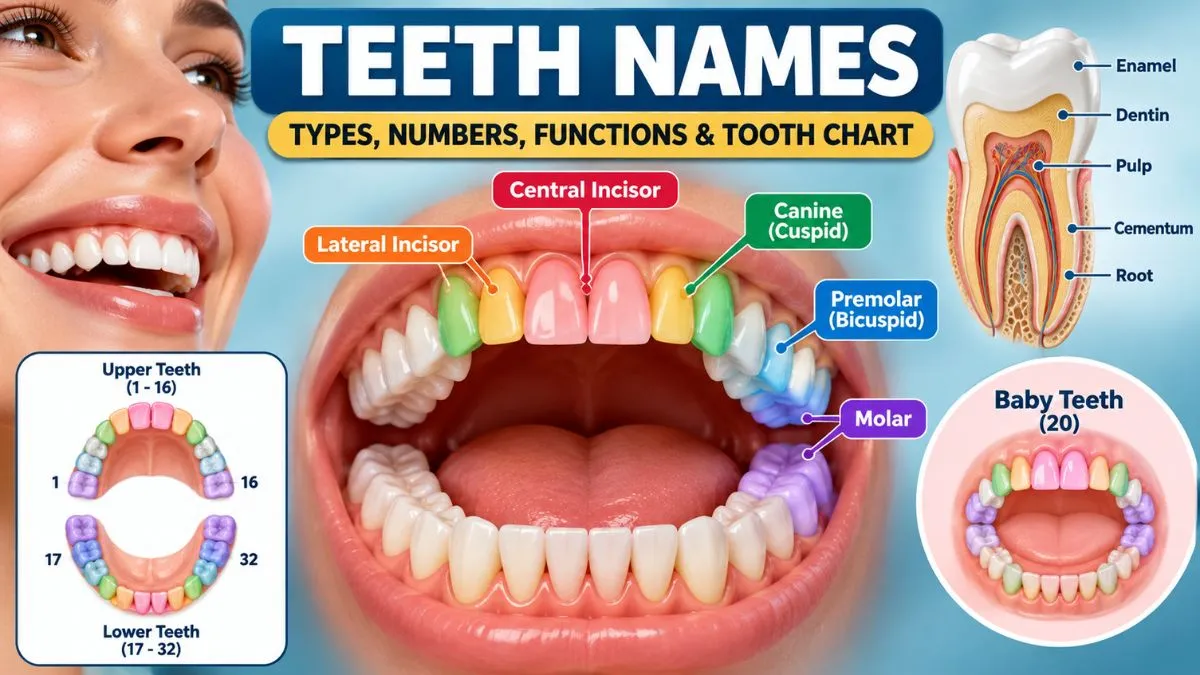
Teeth Names: Types, Numbers, Functions & Tooth Chart
You use your teeth every day to bite, tear, crush, and grind food, but you may not know what each tooth is actually called. Human teeth have specific names based on their location, shape, and function.
Adults can have up to 32 permanent teeth, divided into four main types: incisors, canines, premolars, and molars. Children normally have 20 primary (baby) teeth and don’t have premolars.
This guide explains the names of your teeth, what each type does, where it is located, and how the 1–32 tooth numbering system used by dentists in the United States works.
Quick Checklist
- ✅ Four main adult tooth types: Incisors, canines, premolars, and molars
- ✅ Adult teeth: Up to 32 permanent teeth when all wisdom teeth are present
- ✅ Baby teeth: 20 primary teeth
- ✅ Front teeth: Incisors and canines
- ✅ Back teeth: Premolars and molars
- ✅ Pointed teeth: Canines, also called cuspids
- ✅ Premolars: Also commonly called bicuspids
- ✅ Wisdom teeth: Third molars
- ✅ Upper teeth: Maxillary teeth
- ✅ Lower teeth: Mandibular teeth
Human Teeth Names at a Glance
A complete adult dentition has four major types of teeth.
| Type of Tooth | Number in Complete Adult Dentition | Location | Main Function |
|---|---|---|---|
| Incisors | 8 | Front of the mouth | Biting and cutting |
| Canines | 4 | Beside the lateral incisors | Gripping and tearing |
| Premolars | 8 | Between canines and molars | Crushing and chewing |
| Molars | 12 | Back of the mouth | Grinding and chewing |
| Total | 32 | Upper and lower jaws | — |
The 12 molars include the four third molars, commonly known as wisdom teeth. Someone whose wisdom teeth never develop or have been removed will have fewer than 32 teeth.
See also : Random Name Generator – Generate Male, Female & Full Names
What Are the Names of the Different Teeth?
Moving from the center of an adult mouth toward the back, the teeth are named:
- Central incisor
- Lateral incisor
- Canine
- First premolar
- Second premolar
- First molar
- Second molar
- Third molar
The third molar is the wisdom tooth.
This pattern occurs in each of the four quadrants of a complete permanent dentition.
That means the upper right, upper left, lower left, and lower right portions of the mouth can each contain these eight teeth.
Incisors
Incisors are the eight teeth at the very front of an adult mouth.
There are four in the upper jaw and four in the lower jaw.
They are divided into:
Central Incisors
The central incisors are the teeth immediately beside the center line of your mouth.
You have:
- Two upper central incisors
- Two lower central incisors
These are usually the teeth people notice first when you smile.
Lateral Incisors
Lateral incisors sit directly beside the central incisors.
There are also four:
- Two upper lateral incisors
- Two lower lateral incisors
What Do Incisors Do?
Their relatively thin cutting edges make incisors useful for biting and cutting food.
When you bite into an apple, for example, your incisors do much of the initial cutting.
Canines
Canines are the pointed teeth immediately beside your lateral incisors.
Adults normally have four:
- Two upper canines
- Two lower canines
There is one canine on each side of each dental arch.
Canines are also called cuspids.
Upper canines are sometimes informally called eye teeth because of their position in the upper jaw.
What Do Canines Do?
Their pointed shape helps them grip and tear food.
Canines also form a transition between the flatter incisors at the front and the broader chewing teeth farther back.
Premolars
Premolars sit between the canines and molars.
A complete adult dentition contains eight:
- Four upper premolars
- Four lower premolars
Each quadrant contains:
- First premolar
- Second premolar
Premolars are also commonly called bicuspids.
What Do Premolars Do?
Premolars help crush and chew food before it moves farther back to the molars.
Their chewing surfaces are broader than those of incisors and canines.
Do Children Have Premolars?
No.
Primary, or baby, dentition doesn’t contain premolars. Premolars appear as part of the permanent dentition.
This is one reason adults can have considerably more teeth than young children.
Molars
Molars are the large teeth at the back of the mouth.
They have broad chewing surfaces designed primarily for grinding and chewing food.
A complete adult dentition contains 12 molars:
- Four first molars
- Four second molars
- Four third molars
Each quadrant can therefore contain three molars.
First Molars
The first permanent molars are the first molars encountered when moving backward from the premolars.
There is one in each quadrant.
Second Molars
Second molars sit immediately behind the first molars.
Again, there is one in each quadrant.
Third Molars
Third molars are the final teeth at the very back of the mouth.
They’re better known as wisdom teeth.
What Are Wisdom Teeth?
Wisdom teeth are third molars.
There can be four:
- Upper right third molar
- Upper left third molar
- Lower left third molar
- Lower right third molar
However, not everyone has four erupted wisdom teeth. They may fail to develop, remain impacted, erupt only partly, or be removed.
So although 32 is the standard total for a complete permanent dentition including all third molars, many adults have fewer.
Complete Adult Teeth Names and Numbers Chart
Dentists use numbering systems to identify individual teeth precisely.
In the Universal Numbering System commonly used in the United States, permanent teeth are numbered 1 through 32.
The sequence starts with the upper right third molar as viewed from the patient’s perspective.
It moves across the upper arch:
#1 → #16
It then continues with the lower left third molar:
#17
and moves across the lower arch until reaching the lower right third molar:
#32
Here is the complete chart.
| Tooth Number | Tooth Name |
|---|---|
| 1 | Upper right third molar (wisdom tooth) |
| 2 | Upper right second molar |
| 3 | Upper right first molar |
| 4 | Upper right second premolar |
| 5 | Upper right first premolar |
| 6 | Upper right canine (cuspid) |
| 7 | Upper right lateral incisor |
| 8 | Upper right central incisor |
| 9 | Upper left central incisor |
| 10 | Upper left lateral incisor |
| 11 | Upper left canine (cuspid) |
| 12 | Upper left first premolar |
| 13 | Upper left second premolar |
| 14 | Upper left first molar |
| 15 | Upper left second molar |
| 16 | Upper left third molar (wisdom tooth) |
| 17 | Lower left third molar (wisdom tooth) |
| 18 | Lower left second molar |
| 19 | Lower left first molar |
| 20 | Lower left second premolar |
| 21 | Lower left first premolar |
| 22 | Lower left canine (cuspid) |
| 23 | Lower left lateral incisor |
| 24 | Lower left central incisor |
| 25 | Lower right central incisor |
| 26 | Lower right lateral incisor |
| 27 | Lower right canine (cuspid) |
| 28 | Lower right first premolar |
| 29 | Lower right second premolar |
| 30 | Lower right first molar |
| 31 | Lower right second molar |
| 32 | Lower right third molar (wisdom tooth) |
Easy Way to Understand Tooth Numbers 1–32
You don’t necessarily need to memorize all 32 numbers.
Remember the direction instead.
Upper Teeth
Start at the patient’s upper right:
1 → 2 → 3 → 4 → 5 → 6 → 7 → 8
Cross the middle:
9 → 10 → 11 → 12 → 13 → 14 → 15 → 16
Lower Teeth
Drop down to the patient’s lower left:
17 → 18 → 19 → 20 → 21 → 22 → 23 → 24
Cross the lower center:
25 → 26 → 27 → 28 → 29 → 30 → 31 → 32
So numbers 8 and 9 are the two upper central incisors, while numbers 24 and 25 are the two lower central incisors.
Upper Teeth Names
Teeth in the upper jaw are called maxillary teeth.
A complete permanent upper arch contains 16 teeth:
Upper Right
- Third molar
- Second molar
- First molar
- Second premolar
- First premolar
- Canine
- Lateral incisor
- Central incisor
Upper Left
Moving outward from the center:
- Central incisor
- Lateral incisor
- Canine
- First premolar
- Second premolar
- First molar
- Second molar
- Third molar
Together, these make up the complete maxillary dentition.
Lower Teeth Names
Teeth in the lower jaw are called mandibular teeth.
A complete permanent lower arch also contains 16 teeth.
Each side can contain:
- Central incisor
- Lateral incisor
- Canine
- First premolar
- Second premolar
- First molar
- Second molar
- Third molar
The upper and lower jaws therefore follow the same basic sequence of tooth types, although individual teeth differ in their anatomy.
What Are the Front Teeth Called?
The teeth toward the front of the mouth are commonly described as anterior teeth.
These include the incisors and canines.
In a complete adult dentition, there are:
- 8 incisors
- 4 canines
That gives 12 anterior teeth altogether.
Incisors do much of the cutting and biting, while canines are well suited to gripping and tearing.
What Are the Back Teeth Called?
The back teeth are known as posterior teeth.
In adults, these include:
- Premolars
- Molars
Their wider chewing surfaces make them better suited to crushing, chewing, and grinding food.
A complete adult dentition contains:
- 8 premolars
- 12 molars
for a total of 20 posterior teeth when all four wisdom teeth are present.
Baby Teeth Names
Children have a different set of teeth called primary teeth.
They are also known as:
- Baby teeth
- Primary dentition
- Deciduous teeth
A complete primary dentition has 20 teeth—10 in the upper jaw and 10 in the lower jaw.
The five types/positions in each primary quadrant are:
- Central incisor
- Lateral incisor
- Canine
- First molar
- Second molar
There are no premolars in primary dentition.
How Many of Each Baby Tooth Are There?
| Baby Tooth Type | Number |
|---|---|
| Central incisors | 4 |
| Lateral incisors | 4 |
| Canines | 4 |
| First molars | 4 |
| Second molars | 4 |
| Total | 20 |
Each quadrant contains five primary teeth.
Baby Teeth vs. Adult Teeth
Primary and permanent dentitions differ in both number and arrangement.
| Feature | Baby Teeth | Adult Teeth |
|---|---|---|
| Total teeth | 20 | Up to 32 |
| Incisors | 8 | 8 |
| Canines | 4 | 4 |
| Premolars | 0 | 8 |
| Molars | 8 | Up to 12 |
| Wisdom teeth | 0 | Up to 4 |
One particularly important difference is that baby molars are not permanent premolars.
As permanent teeth develop, primary teeth are eventually replaced as the permanent dentition emerges.
Other Names Dentists Use for Teeth
Dental terminology can initially sound confusing because one tooth may be described in several ways.
Here are some common equivalents.
| Common Term | Other Dental Term |
|---|---|
| Canine | Cuspid |
| Premolar | Bicuspid |
| Third molar | Wisdom tooth |
| Baby teeth | Primary or deciduous teeth |
| Adult teeth | Permanent teeth |
| Upper teeth | Maxillary teeth |
| Lower teeth | Mandibular teeth |
| Front teeth | Anterior teeth |
| Back teeth | Posterior teeth |
Knowing these terms makes dental conversations and treatment plans easier to understand.
Canine vs. Cuspid
Canine and cuspid can refer to the same type of pointed tooth.
Humans normally have four permanent canines.
Premolar vs. Bicuspid
Premolar is the anatomical term for the teeth between the canines and molars.
You may also hear premolars called bicuspids.
A complete adult dentition has eight premolars.
Third Molar vs. Wisdom Tooth
These terms also refer to the same tooth position.
“Third molar” describes its anatomical position, while “wisdom tooth” is the familiar everyday name.
Parts of a Tooth
Knowing the names of the teeth is easier when you also understand a few basic parts of an individual tooth.
Crown
The crown is the portion of the tooth normally visible above the gumline.
It includes the surface you see when you smile and, on posterior teeth, the chewing surface.
Root
The root is the portion anchored below the gumline in the jaw.
Different types of teeth can have different root forms.
Enamel
Enamel forms the hard outer covering of the tooth’s crown.
It protects the underlying tooth structure.
Dentin
Dentin lies beneath the enamel and makes up a substantial portion of the tooth.
Pulp
The pulp is the soft tissue in the central portion of a tooth.
It contains nerves and blood vessels.
Cementum
Cementum covers the root surface and helps support the tooth’s attachment within its socket.
Crown vs. Root
A simple way to remember the distinction is:
Crown = normally visible portion
Root = anchored portion below the gumline
The internal anatomy is more complex, but these terms are enough for understanding basic tooth diagrams.
What Are Maxillary and Mandibular Teeth?
These two terms describe whether a tooth is in the upper or lower jaw.
Maxillary Teeth
Maxillary teeth are the upper teeth.
A complete permanent maxillary arch contains 16 teeth.
Mandibular Teeth
Mandibular teeth are the lower teeth.
A complete permanent mandibular arch also contains 16 teeth.
So:
Maxillary = upper
Mandibular = lower
What Are Anterior and Posterior Teeth?
Dentists can also group teeth according to whether they are toward the front or back of the mouth.
Anterior Teeth
Anterior teeth are toward the front.
They include:
- Central incisors
- Lateral incisors
- Canines
Posterior Teeth
Posterior teeth are farther back.
They include:
- First premolars
- Second premolars
- First molars
- Second molars
- Third molars
These terms are useful because a dentist can describe a general region without naming every individual tooth.
What Is a Dental Quadrant?
The mouth can be divided into four quadrants:
- Upper right
- Upper left
- Lower left
- Lower right
In complete permanent dentition, each quadrant contains eight teeth:
- Central incisor
- Lateral incisor
- Canine
- First premolar
- Second premolar
- First molar
- Second molar
- Third molar
This four-quadrant layout makes tooth location much easier to describe.
Why Do Dentists Number Teeth?
Imagine a dentist telling another dental professional:
“There’s a problem with one of the molars on the right.”
That description still leaves several possibilities.
A standardized tooth number identifies the location much more precisely.
For example, under the U.S. Universal Numbering System:
#8 = upper right central incisor
#9 = upper left central incisor
#14 = upper left first molar
#19 = lower left first molar
#30 = lower right first molar
This makes charting, communication, and treatment documentation clearer.
Different countries and dental systems may use other tooth notation systems, so a number used in one system should not automatically be assumed to mean the same tooth everywhere.
Frequently Asked Questions
What are the four types of teeth?
The four main types of permanent human teeth are incisors, canines, premolars, and molars. Incisors cut food, canines help grip and tear it, premolars help crush and chew it, and molars provide broad surfaces for grinding and chewing.
What are all the teeth called?
Starting at the center and moving toward the back of one quadrant, adult teeth are called the central incisor, lateral incisor, canine, first premolar, second premolar, first molar, second molar, and third molar. The third molar is commonly called a wisdom tooth.
What are the front teeth called?
The flat teeth at the very front are incisors. The broader dental term anterior teeth includes both incisors and canines.
What are the two front teeth called?
The two most prominent upper front teeth are the maxillary central incisors. In the U.S. Universal Numbering System, they’re teeth #8 and #9.
What are the pointy teeth called?
The pointed teeth beside the lateral incisors are called canines or cuspids. Adults normally have four canines.
What are the back teeth called?
Adult back teeth include premolars and molars. Collectively, teeth toward the back of the mouth are referred to as posterior teeth.
What are wisdom teeth called?
The anatomical name for wisdom teeth is third molars. They are the final molars at the back of each quadrant.
What are premolars?
Premolars are permanent teeth located between the canines and molars. A complete adult dentition contains eight premolars.
Are premolars and bicuspids the same thing?
Premolars are also commonly called bicuspids. “Premolar” clearly describes their location immediately before the molars.
How many teeth do adults have?
A complete permanent dentition can contain 32 teeth, including four third molars or wisdom teeth. Adults who don’t have all four wisdom teeth will have fewer.
How many teeth do children have?
A complete primary dentition contains 20 baby teeth: 10 upper and 10 lower.
Do children have premolars?
No. Primary dentition contains incisors, canines, first molars, and second molars but no premolars.
What are teeth numbered 1 to 32?
In the Universal Numbering System used in the United States, permanent teeth are numbered from 1 to 32. Number 1 is the upper right third molar, and the sequence moves across the upper teeth to #16 before continuing from the lower left at #17 and ending at the lower right third molar, #32.
What tooth is number 1?
Tooth #1 is the upper right third molar, commonly called the upper right wisdom tooth, in the U.S. Universal Numbering System.
What tooth is number 8?
Tooth #8 is the upper right central incisor in the Universal Numbering System.
It is one of the two prominent upper front teeth.
What tooth is number 9?
Tooth #9 is the upper left central incisor.
Together, teeth #8 and #9 form the central pair of upper incisors.
What tooth is number 14?
Tooth #14 is the upper left first molar under the U.S. Universal Numbering System.
What tooth is number 19?
Tooth #19 is the lower left first molar.
What tooth is number 30?
Tooth #30 is the lower right first molar.
What is the difference between maxillary and mandibular teeth?
Maxillary teeth are located in the upper jaw, while mandibular teeth are located in the lower jaw.
Are everyone’s teeth numbered the same way?
The numbering depends on the notation system being used. The 1–32 Universal Numbering System described in this guide is commonly used in the United States, while other regions and dental professionals may use different notation systems.
Conclusion
Human teeth names become much easier to understand once you recognize the basic pattern.
Adults have four main types of permanent teeth: incisors, canines, premolars, and molars. Starting from the center of each quadrant, the sequence is central incisor, lateral incisor, canine, first premolar, second premolar, first molar, second molar, and third molar.
A complete permanent dentition can contain 32 teeth, while children have 20 primary teeth and no premolars.
If your dentist mentions a cuspid, bicuspid, maxillary tooth, mandibular tooth, third molar, or a number such as #14 or #30, you can now use the tooth names and numbering chart above to understand exactly which part of your smile they’re talking about.