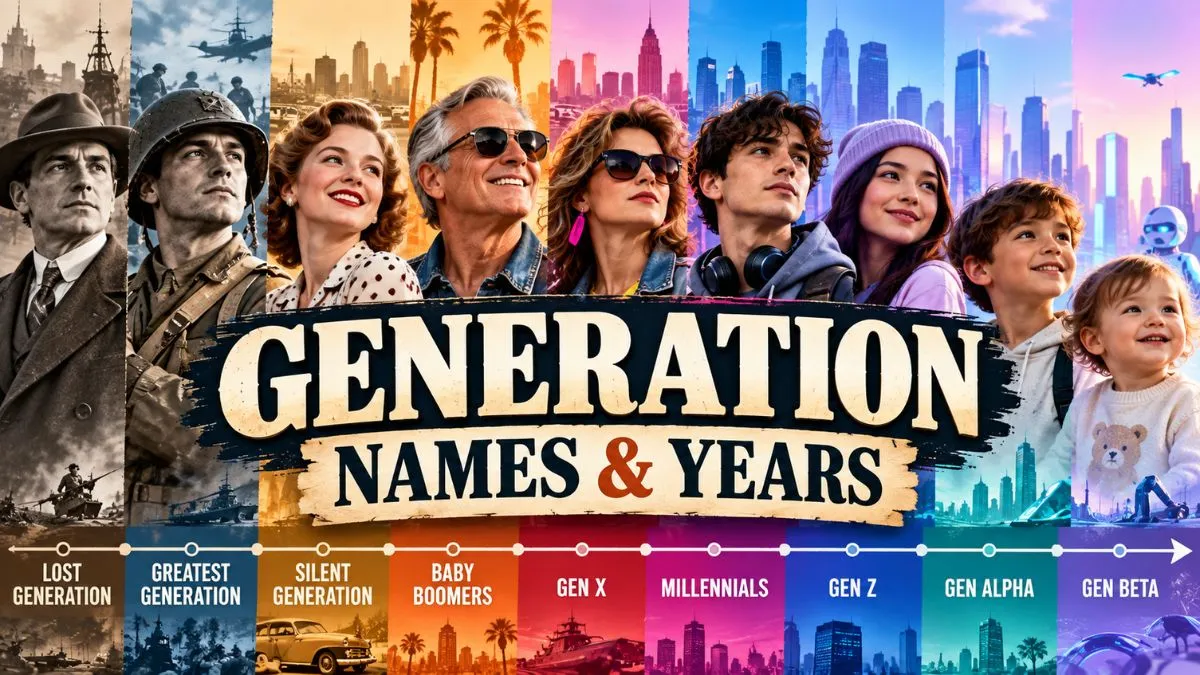
Generation Names and Years: Full List From the Lost Generation to Gen Beta
Generation names such as Baby Boomers, Generation X, Millennials, Gen Z, Gen Alpha, and Gen Beta are commonly used to group people born during similar periods.
These labels can make it easier to discuss broad historical, technological, economic, and cultural changes experienced by people at similar stages of life. However, generation dates aren’t scientific boundaries. Different researchers sometimes use different starting and ending years, especially for newer generations.
Using commonly cited U.S. definitions, the modern sequence runs from the Lost Generation and Greatest Generation through the Silent Generation, Baby Boomers, Gen X, Millennials, Gen Z, Gen Alpha, and the newly proposed Gen Beta.
Generation Names and Years at a Glance
|
Generation Name |
Common Birth Years |
|---|---|
|
Lost Generation |
About 1883–1900 |
|
Greatest Generation |
About 1901–1927 |
|
Silent Generation |
1928–1945 |
|
Baby Boomers |
1946–1964 |
|
Generation X |
1965–1980 |
|
Millennials (Gen Y) |
1981–1996 |
|
Generation Z (Gen Z) |
Commonly 1997–2012 |
|
Generation Alpha |
Often 2010–2024 or early 2010s onward |
|
Generation Beta |
Proposed as 2025–2039 in one widely used framework |
Important: The ranges become less standardized as we move toward younger generations. In particular, Gen Z and Gen Alpha can overlap depending on which research framework you follow.
Quick Checklist
- ✅ Generation boundaries are guidelines rather than biological or scientific divisions.
- ✅ Baby Boomers have one of the clearest historical date ranges: 1946–1964.
- ✅ Gen X is commonly defined as 1965–1980.
- ✅ Millennials are commonly defined as 1981–1996.
- ✅ Gen Z commonly begins in 1997 in the Pew framework.
- ✅ There is less agreement about exactly when Gen Alpha begins.
- ✅ Gen Beta is a newer proposed label rather than a universally standardized demographic category.
- ✅ Someone born near a cutoff may relate to characteristics associated with both neighboring generations.
- ✅ Generational labels shouldn’t be used to assume someone’s personality, beliefs, or behavior.
What Are Generation Names?
Generation names are labels used for groups of people born during broadly similar periods.
You’ve probably heard someone say:
“I’m a Millennial.”
“My parents are Boomers.”
“She’s Gen Z.”
These labels provide convenient shorthand, but they shouldn’t be confused with rigid categories.
Researchers can use birth cohorts to examine how people of different ages experience historical changes. Marketers, journalists, educators, employers, and the general public also use generation names, sometimes much more loosely.
The most familiar sequence today is:
Lost Generation → Greatest Generation → Silent Generation → Baby Boomers → Generation X → Millennials → Generation Z → Generation Alpha → Generation Beta
Let’s look at each one individually.
Lost Generation: About 1883–1900
The Lost Generation generally refers to people born during the late nineteenth century who reached adulthood around World War I.
A commonly cited approximate range is:
1883–1900
Unlike Baby Boomers, however, this isn’t an officially fixed demographic range.
The expression “Lost Generation” became strongly associated with writers and artists who came of age around World War I.
The label is particularly connected with literary figures of the 1920s.
Famous writers associated with the Lost Generation include names such as:
- Ernest Hemingway
- F. Scott Fitzgerald
- Gertrude Stein
- John Dos Passos
The term therefore carries both generational and literary-cultural meanings.
Why Is It Called the Lost Generation?
The phrase came to describe a generation whose early adulthood was profoundly affected by World War I and the social upheaval surrounding it.
It became especially famous through the literary culture surrounding expatriate writers in the years after the war.
Greatest Generation: About 1901–1927
The Greatest Generation generally refers to Americans born during the early decades of the twentieth century.
A commonly used approximate range is:
1901–1927
Members of this cohort experienced major events such as:
World War I during childhood for some
The Great Depression
World War II
Postwar economic and social transformation
The label “Greatest Generation” became particularly well known through journalist Tom Brokaw’s use of the term.
Why Is It Called the Greatest Generation?
The label refers especially to the generation that endured the Great Depression and then participated in the World War II era, both through military service and life on the home front.
“Greatest” is an honorific label rather than a scientific judgment that one generation is objectively better than another.
Silent Generation: 1928–1945
The Silent Generation is commonly defined as people born from:
1928 to 1945
This places the generation between the Greatest Generation and the Baby Boomers.
Members of this cohort were children during periods that included the Great Depression and World War II, although their individual experiences varied considerably by birth year and location.
Someone born in:
1930 → Silent Generation
1935 → Silent Generation
1940 → Silent Generation
1945 → Silent Generation
Why Is It Called the Silent Generation?
The name emerged during the twentieth century and has been connected with perceptions of conformity and caution among young adults of the period.
That shouldn’t be interpreted as a literal description of everyone born between 1928 and 1945.
Like other generation labels, it describes a historical cohort—not a shared personality.
Baby Boomers: 1946–1964
Baby Boomers, often simply called Boomers, have one of the clearest generational ranges:
1946–1964
Unlike many other generation boundaries, these years correspond to a measurable demographic phenomenon: the large increase in U.S. births following World War II and its eventual decline.
Examples:
1946 → Baby Boomer
1950 → Baby Boomer
1955 → Baby Boomer
1960 → Baby Boomer
1964 → Baby Boomer
You may also be interested in: 500+ Western Boy Names: Cowboy, Old West & Country Names With Meanings
Why Are They Called Baby Boomers?
The name comes from the post-World War II baby boom.
Births increased substantially after World War II, creating an unusually large cohort of children.
That demographic origin makes “Baby Boomer” somewhat different from names such as Gen X or Gen Z, whose boundaries are more dependent on research conventions.
Are Boomers and Baby Boomers the Same?
Yes.
Boomer is simply a shortened form of Baby Boomer.
Generation X: 1965–1980
Generation X, usually shortened to Gen X, is commonly defined as:
1965–1980
Examples:
1965 → Gen X
1970 → Gen X
1975 → Gen X
1980 → Gen X
Gen X sits between the Baby Boomers and Millennials.
Why Is It Called Generation X?
Several terms were proposed for the post-Boomer cohort.
“Generation X” eventually became dominant, with the label receiving substantial popular attention after Douglas Coupland’s 1991 novel Generation X: Tales for an Accelerated Culture.
The “X” gave the generation a deliberately less descriptive label than Baby Boomers.
What Was Gen X Called Before Generation X?
Terms such as Baby Bust were sometimes used because birth rates had declined from the Baby Boom era.
Generation X ultimately became the more familiar label.
Millennials: 1981–1996
Millennials are commonly defined in the widely used Pew framework as people born from:
1981–1996
They are also known as Generation Y or Gen Y.
Examples:
1981 → Millennial
1985 → Millennial
1990 → Millennial
1995 → Millennial
1996 → Millennial
Why Are They Called Millennials?
The name reflects the generation’s connection with the turn of the millennium.
Older members entered adulthood around the beginning of the twenty-first century, making Millennials an intuitive replacement for the earlier alphabetical label Generation Y.
Are Millennials and Gen Y the Same?
Generally, yes.
Generation Y was widely used before Millennials became the dominant label.
You may therefore see:
Generation Y
Gen Y
Millennials
used for essentially the same cohort, although exact birth-year definitions can vary by source.
Are People Born in 1996 Millennials?
Under the commonly used Pew definition, yes.
1996 is the final Millennial birth year in that framework.
Because generational boundaries aren’t universal, however, some other systems may place the cutoff differently.
Generation Z: Commonly 1997–2012
Generation Z, usually shortened to Gen Z, follows Millennials.
A frequently used range is:
1997–2012
That means:
1997 → Gen Z
2000 → Gen Z
2005 → Gen Z
2010 → potentially Gen Z, depending on the framework
2012 → Gen Z under a commonly used range
There is an important complication here.
Some frameworks begin Generation Alpha in 2010, creating an overlap with definitions that extend Gen Z through 2012.
This isn’t necessarily an error. It happens because different researchers use different generational systems.
Why Is It Called Generation Z?
Millennials were once widely called Generation Y because they followed Generation X.
The next cohort naturally became:
Generation Z
Several alternative labels were proposed, but Gen Z became the dominant term in popular usage.
Other Names for Generation Z
You may occasionally encounter:
Zoomers
iGen
Post-Millennials
Homeland Generation
But Gen Z is by far the most recognizable general label.
Are People Born in 1997 Gen Z?
Under the commonly used Pew framework, yes.
1997 marks the beginning of Gen Z after Millennials end in 1996.
Generation Alpha: Often 2010–2024
Generation Alpha is the name commonly given to the generation following Gen Z.
One influential framework defines Generation Alpha as:
2010–2024
But unlike the Baby Boomer range, these dates are not universally accepted.
Some definitions start Gen Alpha later in the early 2010s.
This creates the frequently asked question:
Is 2010 Gen Z or Gen Alpha?
It depends on the definition.
A framework ending Gen Z in 2012 can classify someone born in 2010 as Gen Z.
The framework that defines Gen Alpha as 2010–2024 classifies the same person as Gen Alpha.
Therefore, claiming that every person born in 2010 definitively belongs to one generation would hide the genuine disagreement between commonly used systems.
Why Is It Called Generation Alpha?
After Generation X, Generation Y, and Generation Z reached the end of the Latin alphabet, social researcher Mark McCrindle proposed moving to the Greek alphabet.
That produced:
Generation Alpha
followed by:
Generation Beta
The name also emphasizes the idea of beginning a new alphabetical sequence rather than continuing past Z.
Generation Beta: Proposed 2025–2039
Generation Beta, or Gen Beta, is the newest generation name you’ll increasingly encounter.
Under the framework developed by McCrindle, Gen Beta covers:
2025–2039
Therefore, a baby born in:
2025 → Gen Beta under this framework
2026 → Gen Beta
2030 → Gen Beta
2035 → Gen Beta
2039 → Gen Beta
However, Gen Beta is still a new and proposed generational classification rather than a universally standardized demographic boundary.
Most members of this proposed generation haven’t even been born yet.
Why Is It Called Generation Beta?
The name continues the Greek-alphabet sequence started with Generation Alpha:
Alpha → Beta → Gamma → Delta
Under that naming system, Beta naturally follows Alpha.
What Comes After Generation Beta?
If the same system continues, the proposed next name would be:
Generation Gamma
Under a simple 15-year framework, that would correspond approximately to:
2040–2054
However, these future names and dates should not be treated as settled facts.
Generational terminology evolves over time, and future researchers or popular culture may adopt different labels.
Generation Names in Order
For quick reference, the commonly used sequence is:
- Lost Generation
- Greatest Generation
- Silent Generation
- Baby Boomers
- Generation X
- Millennials / Generation Y
- Generation Z
- Generation Alpha
- Generation Beta
The sequence becomes progressively less standardized as it reaches the newest generations.
What Generation Am I?
Use your birth year as a quick starting point.
| Your Birth Year | Likely Generation |
|---|---|
| 1928–1945 | Silent Generation |
| 1946–1964 | Baby Boomer |
| 1965–1980 | Generation X |
| 1981–1996 | Millennial |
| 1997–2009 | Generation Z under both commonly encountered frameworks |
| 2010–2012 | Gen Z or Gen Alpha, depending on framework |
| 2013–2024 | Usually described as Gen Alpha in current popular frameworks |
| 2025 onward | Gen Beta under the 2025–2039 framework |
The table deliberately shows the uncertainty around the 2010–2012 period instead of pretending every source agrees.
Generation by Birth Year
Here’s another quick way to identify your generation.
Born in the 1940s
Someone born from 1940–1945 falls within the Silent Generation under a commonly used framework.
Someone born from 1946 onward enters the Baby Boomer cohort.
Born in the 1950s
People born throughout the 1950s are Baby Boomers under the standard 1946–1964 range.
Born in the 1960s
The decade is divided:
1960–1964 → Baby Boomers
1965–1969 → Generation X
Born in the 1970s
People born throughout the 1970s are generally considered Generation X.
Born in the 1980s
The decade crosses another boundary:
1980 → Generation X
1981–1989 → Millennials
Born in the 1990s
Under the common Pew framework:
1990–1996 → Millennials
1997–1999 → Generation Z
Born in the 2000s
People born throughout 2000–2009 are generally categorized as Gen Z under commonly encountered definitions.
Born in the 2010s
This is where definitions become less consistent.
Depending on the framework, people born during the early 2010s may be categorized as Gen Z or Gen Alpha.
Later 2010s births are generally called Gen Alpha.
Born in the 2020s
People born during the early 2020s are generally categorized as Gen Alpha in current popular usage.
Under the 2025–2039 framework:
2020–2024 → Gen Alpha
2025–2029 → Gen Beta
Why Do Generation Years Vary?
This is one of the most important things to understand about generation names.
There is no universal authority that announces:
“This generation officially begins today.”
Researchers create cohort boundaries to make demographic and social analysis easier.
They may consider:
Birth-rate changes
Major historical events
Economic conditions
Wars
Technological developments
Social changes
Cultural experiences
The age at which people experienced important events
Different researchers can reasonably emphasize different factors and reach different boundaries.
That’s why one website might end Gen Z in 2009, while another extends it to 2012.
Neither difference necessarily means one source made a typo.
They may simply be using different frameworks.
Why Are Generations Usually About 15 to 20 Years?
Many modern generational cohorts span roughly 15 to 20 years, but there is no rule requiring every generation to have exactly the same length.
For example:
Baby Boomers → 1946–1964
Gen X → 1965–1980
Millennials → 1981–1996
Those periods aren’t identical in length.
Generations are analytical tools rather than natural units of time.
A researcher may select boundaries based partly on whether people were old enough to remember or be shaped by particular historical events.
Who Decides Generation Names?
There is no single worldwide organization responsible for naming generations.
Generation names emerge through a combination of:
Researchers
Writers
Journalists
Demographers
Authors
Marketers
Popular culture
Some proposed names disappear, while others become widely accepted.
Generation Z is a good example.
Several alternatives circulated before Gen Z became the dominant term.
This is also why today’s proposed names for future generations shouldn’t automatically be treated as permanent.
Why Is Baby Boomer More Clearly Defined?
The Baby Boomer generation differs from many later generations because its boundaries are tied closely to an observable demographic event.
After World War II, the United States experienced a major increase in births.
The boom began in 1946 and continued through 1964, after which birth rates declined substantially.
That’s why the 1946–1964 range is much less disputed than boundaries for generations such as Gen Z or Gen Alpha.
Why Did Gen Y Become Millennials?
After Generation X, it seemed logical to call the next cohort Generation Y.
And for a while, people did.
However, Millennials became more popular because the name captured something meaningful about the cohort: its oldest members were entering adulthood around the new millennium.
Today, both terms are recognizable, but Millennials is much more commonly used.
Why Did Generation Z Keep Its Letter?
Generation Z followed the alphabetical sequence:
Generation X → Generation Y → Generation Z
Unlike Gen Y, no alternative label became strong enough to completely replace the letter-based name.
Terms such as iGen and Post-Millennials have been proposed or used, but Gen Z became the dominant everyday label.
Why Did We Go From Gen Z to Gen Alpha?
Once the sequence reached Z, there was no next letter in the Latin alphabet.
Instead of restarting with Generation A, the Generation Alpha framework moved to the Greek alphabet.
That gives us:
Alpha
Beta
Gamma
Delta
Whether society continues using this sequence for generations born decades from now remains to be seen.
What Are Microgenerations?
A microgeneration is an informal group positioned around the boundary between two larger generations.
These labels are especially popular among people who feel their childhood experiences don’t fit neatly into either neighboring generation.
Two well-known examples are:
Xennials
and
Zillennials
Unlike Baby Boomers or Millennials, these aren’t standardized demographic generations.
What Are Xennials?
Xennials describes people near the boundary between Generation X and Millennials.
You’ll often see approximate ranges centered around the late 1970s and early 1980s.
Someone born in this period might remember an analog childhood but have experienced the rise of personal computers and the internet during adolescence or early adulthood.
The term is useful conversationally, but it doesn’t replace Gen X or Millennial classifications in most formal demographic research.
What Are Zillennials?
Zillennials describes people near the boundary between Millennials and Generation Z.
The term usually refers loosely to people born in the mid-to-late 1990s.
Someone born around this transition may identify with experiences commonly associated with both cohorts.
Again, there is no universally accepted Zillennial birth-year range.
What Are Generation Jones and Other Cusp Groups?
Another term you may encounter is Generation Jones.
It is sometimes used for people born toward the later part of the Baby Boomer era and around the transition toward Gen X.
Other informal labels have been suggested for different generational boundaries.
These microgeneration terms can be useful when discussing cultural experiences, but their dates tend to be even less standardized than the major generation names.
Generations and Technology
Technology is frequently used when describing generational experiences.
For example, different cohorts encountered:
Radio
Television
Personal computers
The internet
Mobile phones
Smartphones
Social media
Streaming
Generative artificial intelligence
at different ages.
A Baby Boomer may have encountered television as an expanding technology during childhood, while younger generations grew up with digital technologies already embedded in everyday life.
But these comparisons require caution.
Access to technology varies greatly according to:
Country
Income
Urban or rural location
Family circumstances
Education
Infrastructure
Two people born in exactly the same year can therefore have dramatically different technological childhoods.
Generations and Major Historical Events
Researchers sometimes consider formative historical experiences when drawing generational boundaries.
Examples may include:
World wars
The Great Depression
Postwar demographic changes
The Cold War
The rise of personal computing
The expansion of the internet
Major recessions
The spread of smartphones
The COVID-19 pandemic
However, the impact of an event depends heavily on someone’s age when it occurred.
A toddler, teenager, and 30-year-old can experience the same historical event very differently.
This is one reason researchers pay attention to birth cohorts.
Are Generational Stereotypes Accurate?
Not reliably at the individual level.
Statements such as:
“All Boomers hate technology.”
“All Millennials behave the same way.”
“Gen Z has a particular personality.”
are sweeping stereotypes.
People within the same generation differ by:
Personality
Culture
Country
Education
Income
Family background
Race and ethnicity
Religion
Location
Life experiences
Political beliefs
and many other factors.
Generational research can sometimes identify differences between large groups, but an average group difference doesn’t tell you how a particular person thinks or behaves.
Generation Names Around the World
Generation labels such as Boomers, Millennials, Gen Z, and Gen Alpha are now used internationally, but their historical foundations often come heavily from American and other Western experiences.
That creates an important limitation.
For example, World War II, postwar birth patterns, economic development, internet adoption, and political events affected countries differently.
A person born in the United States in 1970 and someone born in another part of the world in 1970 share a birth year, but they may not share the same formative experiences.
Generation names can therefore be convenient internationally without perfectly describing every society.
Complete Generation Timeline
Here’s the timeline in simple form:
1883–1900 → Lost Generation
1901–1927 → Greatest Generation
1928–1945 → Silent Generation
1946–1964 → Baby Boomers
1965–1980 → Generation X
1981–1996 → Millennials
1997 onward → Generation Z begins under the Pew framework
For younger generations, one popular alternative framework continues:
2010–2024 → Generation Alpha
2025–2039 → Generation Beta
2040–2054 → Generation Gamma, if the proposed naming sequence continues
The overlap between Gen Z and Alpha demonstrates exactly why generation dates should be treated as framework-dependent rather than universal facts.
Generation Name Meanings
|
Generation |
Why the Name Is Used |
|---|---|
|
Lost Generation |
Associated with the cohort shaped by World War I and its aftermath |
|
Greatest Generation |
Honorific popularized for the generation shaped by the Depression and WWII |
|
Silent Generation |
Historical label associated with perceptions of conformity/caution |
|
Baby Boomers |
Named for the post-WWII increase in births |
|
Generation X |
“X” became the dominant label for the post-Boomer cohort |
|
Millennials |
Came of age around the new millennium |
|
Generation Z |
Followed Generation Y alphabetically |
|
Generation Alpha |
Began a proposed Greek-alphabet naming sequence |
|
Generation Beta |
Proposed successor to Generation Alpha |
How We Define Generation Names and Years
For older modern generations, we prioritize ranges that have become widely used in demographic research.
That gives us the familiar sequence:
Silent Generation: 1928–1945
Baby Boomers: 1946–1964
Generation X: 1965–1980
Millennials: 1981–1996
For younger generations, we don’t pretend the boundaries are equally settled.
Gen Z is commonly placed beginning in 1997, while some widely circulated frameworks end it in 2009 and begin Alpha in 2010. Other definitions extend Gen Z into the early 2010s.
Similarly, the 2025–2039 Gen Beta range belongs to a particular generational framework rather than an official worldwide demographic classification.
This distinction matters because a generation chart should help readers understand the terminology—not hide disagreement between sources.
FAQs About Generation Names
What are all the generation names?
The commonly recognized sequence is Lost Generation, Greatest Generation, Silent Generation, Baby Boomers, Generation X, Millennials (Gen Y), Generation Z, Generation Alpha, and Generation Beta.
What are the generations in order?
From older to younger:
Lost → Greatest → Silent → Baby Boomers → Gen X → Millennials → Gen Z → Gen Alpha → Gen Beta
What generation is 1945?
Using the commonly cited 1928–1945 range, someone born in 1945 belongs to the Silent Generation.
What generation is 1946?
Someone born in 1946 is a Baby Boomer under the widely used 1946–1964 definition.
What generation is 1964?
1964 is generally the final Baby Boomer birth year.
What generation is 1965?
Someone born in 1965 is generally considered Generation X.
What generation is 1980?
Using the common 1965–1980 definition, someone born in 1980 is Gen X.
What generation is 1981?
Under the widely used Pew definition, 1981 is the first Millennial birth year.
What generation is 1995?
Someone born in 1995 is generally considered a Millennial under the common 1981–1996 definition.
What generation is 1996?
Under the widely used Pew framework, 1996 is the final Millennial birth year.
What generation is 1997?
Under that same framework, 1997 marks the beginning of Generation Z.
What generation is 2000?
Someone born in 2000 is Generation Z under commonly used definitions.
What generation is 2005?
Someone born in 2005 is generally considered Gen Z.
What generation is 2010?
This depends on the definition.
Some frameworks classify 2010 as Generation Alpha, while definitions extending Gen Z through 2012 classify a 2010 birth as Gen Z.
2010 is therefore one of the clearest examples of why generation boundaries aren’t universal.
What generation is 2012?
2012 may be classified as Gen Z or Gen Alpha depending on the framework used.
What generation is 2013?
2013 is generally associated with Generation Alpha in many current frameworks, although exact Alpha boundaries still vary.
What generation is 2020?
Someone born in 2020 is generally described as Generation Alpha.
What generation is 2024?
Under the 2010–2024 framework, 2024 is the final year of Generation Alpha.
Other definitions may use different Alpha boundaries.
What generation is 2025?
Under the framework defining Gen Beta as 2025–2039, babies born in 2025 are Generation Beta.
Because Gen Beta is still a developing label, that classification isn’t a universally official boundary.
What generation is 2026?
Under the proposed 2025–2039 range, a child born in 2026 is part of Generation Beta.
What comes after Millennials?
Generation Z comes after Millennials.
What comes after Gen Z?
Generation Alpha is the commonly used name for the generation following Gen Z.
What comes after Gen Alpha?
Generation Beta is the proposed name that follows Generation Alpha in the Greek-alphabet system.
What comes after Gen Beta?
If the proposed Greek-alphabet system continues, Generation Gamma would follow Gen Beta.
That future label isn’t guaranteed to become the term society ultimately adopts.
Is Gen Y the same as Millennials?
Yes, Generation Y and Millennials generally refer to the same generation.
Millennials eventually became the more popular name.
Is Gen Z the same as Zoomers?
Zoomer is an informal nickname for a member of Generation Z.
Gen Z remains the more standard term.
Are generation dates official?
Generally, no.
Generation boundaries are analytical and cultural conventions, and different researchers may choose different dates.
The Baby Boomer range is unusually well defined because it corresponds to the measurable post-World War II increase and subsequent decline in U.S. births.
How many years are in a generation?
Modern named generations often cover roughly 15 to 20 birth years, but there is no universal rule.
In genealogy or family history, the word generation can also have a different meaning, referring to stages of descent such as grandparents, parents, children, and grandchildren.
Why do generation names matter?
Generation names provide convenient shorthand for discussing people who passed through similar stages of life during particular historical periods.
They can be useful for demographic analysis, but they shouldn’t be treated as personality types.
Conclusion
Generation names provide a simple way to organize more than a century of changing birth cohorts.
The familiar modern timeline moves from the Lost Generation and Greatest Generation through the Silent Generation, Baby Boomers, Generation X, Millennials, Generation Z, Generation Alpha, and now the proposed Generation Beta.
Some boundaries are more established than others. Baby Boomers are widely defined as 1946–1964, Gen X as 1965–1980, and Millennials as 1981–1996. Definitions become less uniform around Gen Z and Gen Alpha, while the 2025–2039 Gen Beta range belongs to a newer framework and shouldn’t be mistaken for an official worldwide classification.
So if two reliable sources give slightly different answers for someone born near a generational cutoff, that doesn’t necessarily mean either source is wrong. Generation names are useful tools for discussing broad historical cohorts—not hard lines separating one kind of person from another.