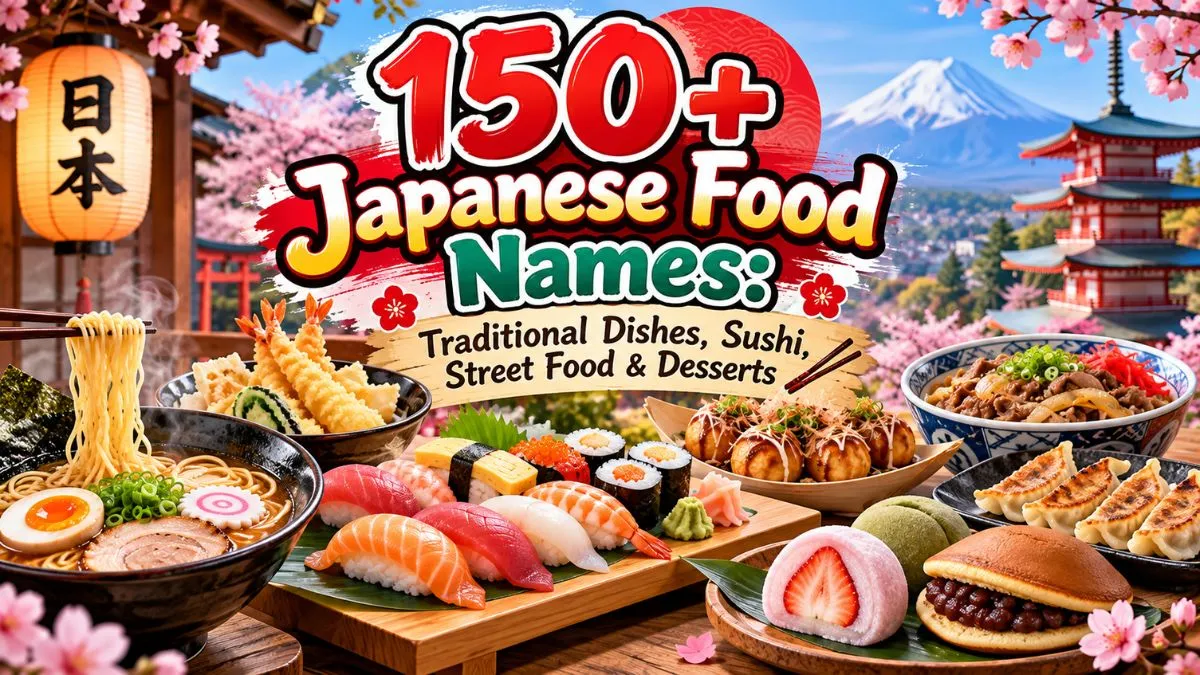
150+ Japanese Food Names: Traditional Dishes, Sushi, Street Food & Desserts
Japanese food names can tell you a lot about what is on the plate. Some describe the main ingredient, while others refer to a cooking method, serving style, region, or type of meal. Learning a few of these names makes a Japanese restaurant menu much easier to understand.
Japanese cuisine also goes far beyond sushi and ramen. Rice bowls, noodles, grilled meats, seafood, hot pots, savory pancakes, pickles, tofu dishes, street foods, and beautifully made sweets all have their own place in Japanese food culture.
Below you’ll find 150+ Japanese food names, including their Japanese writing and simple explanations of what each dish actually is.
Quick Checklist
- ✅ Most famous Japanese foods: Sushi, ramen, tempura, sashimi, udon, soba
- ✅ Popular rice dishes: Onigiri, gyudon, katsudon, oyakodon, curry rice
- ✅ Popular noodle dishes: Ramen, udon, soba, yakisoba, somen
- ✅ Japanese street foods: Takoyaki, yakisoba, taiyaki, yakitori, imagawayaki
- ✅ Popular meat dishes: Tonkatsu, yakiniku, karaage, yakitori, shabu-shabu
- ✅ Popular seafood dishes: Sashimi, unagi, grilled fish, kaisendon
- ✅ Popular Japanese desserts: Mochi, daifuku, dorayaki, taiyaki, dango
- ✅ Good foods for beginners: Ramen, gyoza, chicken karaage, tonkatsu, yakitori
Japanese Food Names at a Glance
| Japanese Food | Japanese | Type | What It Is |
|---|---|---|---|
| Sushi | 寿司 | Rice/Seafood | Vinegared rice with various toppings or fillings |
| Sashimi | 刺身 | Seafood | Thinly sliced raw seafood |
| Ramen | ラーメン | Noodles | Wheat noodles served in broth |
| Udon | うどん | Noodles | Thick wheat noodles |
| Soba | そば | Noodles | Buckwheat noodles |
| Tempura | 天ぷら | Fried | Lightly battered and fried ingredients |
| Onigiri | おにぎり | Rice | Shaped rice, often with a filling |
| Gyudon | 牛丼 | Rice bowl | Rice topped with beef and onions |
| Yakitori | 焼き鳥 | Grilled | Skewered grilled chicken |
| Takoyaki | たこ焼き | Street food | Savory batter balls with octopus |
| Tonkatsu | とんかつ | Meat | Breaded deep-fried pork cutlet |
| Gyoza | 餃子 | Dumplings | Japanese-style pan-fried dumplings |
| Okonomiyaki | お好み焼き | Savory dish | Cabbage-based savory pancake |
| Miso Shiru | 味噌汁 | Soup | Miso soup |
| Mochi | 餅 | Sweet/Rice cake | Glutinous rice cake |
| Dorayaki | どら焼き | Sweet | Pancake-like cakes with sweet bean filling |
See also: 100+ Starbucks Drinks Names: Complete Coffee, Tea, Refresher & Frappuccino List
Famous Japanese Food Names
These are some of the Japanese dishes you’re most likely to encounter in restaurants both inside and outside Japan.
- Sushi (寿司) – Vinegared rice served with seafood, vegetables, egg, or other toppings and fillings.
- Sashimi (刺身) – Carefully sliced raw seafood served without sushi rice.
- Ramen (ラーメン) – Wheat noodles served in a savory broth with various toppings.
- Tempura (天ぷら) – Seafood or vegetables coated in a light batter and fried.
- Udon (うどん) – Thick, chewy wheat noodles served hot or cold.
- Soba (そば) – Thin noodles made primarily with buckwheat flour, sometimes blended with wheat flour.
- Yakitori (焼き鳥) – Pieces of chicken grilled on skewers, often seasoned with salt or sauce.
- Tonkatsu (とんかつ) – Pork cutlet coated with breadcrumbs and deep-fried.
- Okonomiyaki (お好み焼き) – Savory pancake commonly made with cabbage and assorted additions.
- Takoyaki (たこ焼き) – Round savory batter snacks traditionally containing pieces of octopus.
- Onigiri (おにぎり) – Hand-shaped rice, often wrapped in nori and sometimes filled.
- Gyoza (餃子) – Japanese-style dumplings commonly filled with ground meat and vegetables.
- Karaage (唐揚げ) – Japanese frying technique especially associated with seasoned fried chicken.
- Miso Shiru (味噌汁) – Soup made using miso paste and dashi.
- Shabu-Shabu (しゃぶしゃぶ) – Hot pot in which thin slices of meat and vegetables are cooked at the table.
- Sukiyaki (すき焼き) – Hot-pot-style dish with meat, vegetables, tofu, and a sweet-savory seasoning.
- Yakiniku (焼肉) – Meat grilled at the table, often in bite-size pieces.
- Unagi (うなぎ) – Freshwater eel, commonly grilled and glazed with a sweet-savory sauce.
- Japanese Curry / Kare (カレー) – Thick, mildly spiced Japanese-style curry.
- Oden (おでん) – Simmered dish containing ingredients such as daikon, eggs, fish cakes, and konjac.
Traditional Japanese Dishes
Japanese cuisine includes many dishes that emphasize seasonal ingredients, broth, rice, seafood, vegetables, and relatively simple preparations.
- Chawanmushi (茶碗蒸し) – Savory steamed egg custard containing ingredients such as chicken, mushrooms, or seafood.
- Nimono (煮物) – General term for foods simmered in seasoned liquid.
- Tsukemono (漬物) – Japanese pickled vegetables served with meals.
- Hiyayakko (冷奴) – Chilled tofu typically served with simple toppings and seasonings.
- Yudofu (湯豆腐) – Tofu gently heated in water or kombu-based broth.
- Nasu Dengaku (なす田楽) – Eggplant cooked with a sweet-savory miso topping.
- Kinpira Gobo (きんぴらごぼう) – Burdock root and carrot cooked in a sweet-savory style.
- Hijiki no Nimono (ひじきの煮物) – Simmered hijiki seaweed, often prepared with vegetables and other ingredients.
- Gomaae (胡麻和え) – Vegetables dressed with a sesame-based mixture.
- Sunomono (酢の物) – Vinegar-dressed dish, often made with cucumber and seafood or seaweed.
- Namasu (なます) – Thinly sliced vegetables seasoned with sweetened vinegar.
- Agedashi Dofu (揚げ出し豆腐) – Lightly fried tofu served in a seasoned dashi-based broth.
- Tamago Kake Gohan (卵かけご飯) – Hot rice mixed or topped with raw egg and seasonings.
- Ochazuke (お茶漬け) – Rice served with tea or broth poured over it and various toppings.
- Takikomi Gohan (炊き込みご飯) – Rice cooked together with seasoned vegetables, mushrooms, meat, or seafood.
Japanese Rice Dish Names
Rice is central to Japanese cooking, and many dishes are built around a bowl of freshly cooked rice.
- Gohan (ご飯) – Cooked rice; the word can also be used in relation to a meal.
- Onigiri (おにぎり) – Shaped rice, frequently filled and wrapped partly in nori.
- Donburi (丼) – General name for a bowl of rice topped with meat, seafood, eggs, or vegetables.
- Gyudon (牛丼) – Rice bowl topped with thinly sliced beef and onions.
- Oyakodon (親子丼) – Rice bowl topped with chicken and egg.
- Katsudon (カツ丼) – Rice bowl topped with pork cutlet, egg, and onions.
- Tendon (天丼) – Rice bowl topped with tempura.
- Unadon (うな丼) – Rice bowl topped with grilled eel.
- Tekka Don (鉄火丼) – Rice bowl topped with slices of raw tuna.
- Kaisendon (海鮮丼) – Rice bowl topped with assorted seafood.
- Soboro Don (そぼろ丼) – Rice bowl often topped with seasoned minced meat and egg.
- Butadon (豚丼) – Rice bowl topped with pork.
- Negitoro Don (ねぎとろ丼) – Rice bowl topped with minced or finely chopped fatty tuna and green onion.
- Curry Rice (カレーライス) – Japanese curry served over rice.
- Omurice (オムライス) – Seasoned rice wrapped or topped with an omelet.
- Hayashi Rice (ハヤシライス) – Rice served with a rich beef-and-onion demi-glace-style sauce.
- Chahan (チャーハン) – Japanese-style fried rice.
- Sekihan (赤飯) – Glutinous rice cooked with red beans, traditionally associated with celebrations.
- Okayu (お粥) – Japanese rice porridge.
- Kuri Gohan (栗ご飯) – Rice cooked with chestnuts.
Sushi Names
Sushi isn’t a single dish. Different styles describe how the rice, toppings, and fillings are assembled.
- Nigiri Sushi (握り寿司) – Hand-formed sushi rice topped with seafood or another ingredient.
- Maki Sushi (巻き寿司) – Sushi rice and fillings rolled together, usually with nori.
- Hosomaki (細巻き) – Thin sushi roll with a relatively simple filling.
- Futomaki (太巻き) – Thick sushi roll containing several fillings.
- Temaki (手巻き) – Hand-rolled cone-shaped sushi.
- Gunkan Maki (軍艦巻き) – Oval rice wrapped with nori to hold loose toppings.
- Chirashizushi (ちらし寿司) – Sushi rice topped or scattered with assorted ingredients.
- Inarizushi (いなり寿司) – Sushi rice placed inside seasoned fried tofu pockets.
- Oshizushi (押し寿司) – Pressed sushi formed in a mold.
- Temarizushi (手まり寿司) – Small decorative ball-shaped sushi.
Common Sushi Topping Names
- Maguro (まぐろ) – Tuna.
- Toro (トロ) – Fatty tuna.
- Sake / Shake (サーモン / 鮭) – Salmon, depending on context and terminology used.
- Ebi (えび) – Shrimp.
- Ika (いか) – Squid.
- Tako (たこ) – Octopus.
- Hotate (ホタテ) – Scallop.
- Uni (うに) – Sea urchin roe.
- Ikura (いくら) – Salmon roe.
- Tamago (卵) – Egg; in sushi restaurants this often refers to sweet rolled omelet.
Japanese Noodle Dish Names
Japan has several major noodle traditions, with regional variations in broth, toppings, thickness, and preparation.
- Shoyu Ramen (醤油ラーメン) – Ramen characterized by soy-sauce seasoning.
- Miso Ramen (味噌ラーメン) – Ramen with miso-based seasoning.
- Shio Ramen (塩ラーメン) – Ramen seasoned primarily with salt.
- Tonkotsu Ramen (豚骨ラーメン) – Ramen known for its pork-bone-based broth.
- Tsukemen (つけ麺) – Noodles served separately and dipped into concentrated broth.
- Abura Soba (油そば) – Brothless noodles mixed with sauce and oil.
- Kake Udon (かけうどん) – Udon served in a simple hot broth.
- Kitsune Udon (きつねうどん) – Udon topped with seasoned fried tofu.
- Tempura Udon (天ぷらうどん) – Udon served with tempura.
- Curry Udon (カレーうどん) – Thick udon noodles served with curry-flavored broth.
- Nabeyaki Udon (鍋焼きうどん) – Udon cooked and served in an individual hot pot.
- Zaru Soba (ざるそば) – Chilled soba served with dipping sauce.
- Kake Soba (かけそば) – Soba served in hot broth.
- Tempura Soba (天ぷらそば) – Soba accompanied by tempura.
- Kitsune Soba (きつねそば) – Soba topped with seasoned fried tofu.
- Yakisoba (焼きそば) – Stir-fried wheat noodles with vegetables, sauce, and often meat.
- Somen (そうめん) – Very thin wheat noodles commonly served chilled in warmer months.
- Hiyamugi (冷麦) – Thin wheat noodles generally thicker than somen but thinner than typical udon.
- Nagashi Somen (流しそうめん) – Somen served flowing through chilled water, traditionally caught with chopsticks.
- Yaki Udon (焼きうどん) – Stir-fried udon noodles.
Japanese Meat & Chicken Dishes
- Tonkatsu (とんかつ) – Breaded and deep-fried pork cutlet.
- Karaage (唐揚げ) – Seasoned ingredients fried without the thick breadcrumb coating used for katsu; chicken is especially common.
- Chicken Katsu (チキンカツ) – Breaded fried chicken cutlet.
- Yakitori (焼き鳥) – Grilled chicken skewers.
- Tsukune (つくね) – Seasoned minced-meat mixture, commonly chicken, often shaped and grilled.
- Tebasaki (手羽先) – Chicken wings; the term is especially associated with seasoned fried wings in Nagoya cuisine.
- Shogayaki (生姜焼き) – Thinly sliced pork cooked with ginger-flavored seasoning.
- Butajiru / Tonjiru (豚汁) – Miso-based soup containing pork and vegetables.
- Yakiniku (焼肉) – Japanese-style grilled meat.
- Shabu-Shabu (しゃぶしゃぶ) – Thin meat slices briefly swished through hot broth.
- Sukiyaki (すき焼き) – Thin meat and other ingredients cooked in sweet-savory seasoning.
- Nikujaga (肉じゃが) – Home-style simmered meat, potatoes, and vegetables.
- Kakuni (角煮) – Slowly braised cubes of pork belly.
- Gyukatsu (牛カツ) – Breaded beef cutlet.
- Kushikatsu (串カツ) – Breaded and fried ingredients served on skewers.
Japanese Seafood Dishes
Japan’s geography has helped make fish and shellfish central to many regional and national dishes.
- Sashimi (刺身) – Sliced raw seafood served without rice.
- Unagi Kabayaki (うなぎ蒲焼) – Eel grilled with a sweet-savory glaze.
- Unaju (うな重) – Glazed grilled eel served over rice in a lacquered box.
- Shioyaki (塩焼き) – Fish or other ingredients grilled simply with salt.
- Saba Shioyaki (鯖の塩焼き) – Salt-grilled mackerel.
- Sanma Shioyaki (さんまの塩焼き) – Salt-grilled Pacific saury.
- Buri Daikon (ぶり大根) – Yellowtail simmered with daikon radish.
- Aji Fry (アジフライ) – Breaded and fried horse mackerel.
- Ebi Fry (エビフライ) – Breaded deep-fried shrimp.
- Kaki Fry (カキフライ) – Breaded fried oysters.
- Ankimo (あん肝) – Monkfish liver, often steamed and served as a delicacy.
- Tataki (たたき) – Preparation often involving seafood or meat seared on the outside and sliced.
Japanese Street Food Names
Japanese street foods are especially associated with festivals, shopping districts, tourist areas, and regional food scenes.
- Takoyaki (たこ焼き) – Round batter snacks containing octopus pieces.
- Okonomiyaki (お好み焼き) – Savory cabbage-based pancake with customizable additions.
- Yakisoba (焼きそば) – Stir-fried noodles commonly sold at festivals.
- Yakitori (焼き鳥) – Grilled chicken skewers.
- Ikayaki (いか焼き) – Grilled squid or a squid-based savory preparation, depending on regional style.
- Yaki Tomorokoshi (焼きとうもろこし) – Grilled corn, often brushed with soy-based seasoning.
- Jaga Butter (じゃがバター) – Hot potato served with butter.
- Korokke (コロッケ) – Japanese croquette, often made with mashed potato and meat.
- Menchi Katsu (メンチカツ) – Breaded fried minced-meat patty.
- Karaage (唐揚げ) – Bite-size fried chicken commonly sold as a snack.
- Taiyaki (たい焼き) – Fish-shaped cake commonly filled with sweet red bean paste or other fillings.
- Imagawayaki (今川焼き) – Round filled cake traditionally made with sweet red bean paste.
- Dango (団子) – Chewy rice-flour dumplings, frequently served on skewers.
- Crepes (クレープ) – Japanese-style thin crepes popular with sweet or savory fillings.
- Kakigori (かき氷) – Shaved ice flavored with syrup and various toppings.
Japanese Hot Pot Names
Hot pots are especially comforting during colder weather and are often shared at the table.
- Nabe / Nabemono (鍋 / 鍋物) – General terms associated with Japanese hot-pot dishes.
- Shabu-Shabu (しゃぶしゃぶ) – Thinly sliced ingredients cooked quickly in hot broth.
- Sukiyaki (すき焼き) – Meat and vegetables simmered in sweet-savory seasoning.
- Chanko Nabe (ちゃんこ鍋) – Protein-rich hot pot famously associated with sumo wrestlers.
- Yosenabe (寄せ鍋) – Mixed hot pot containing assorted meat, seafood, tofu, or vegetables.
- Motsunabe (もつ鍋) – Hot pot featuring beef or pork offal, particularly associated with Fukuoka.
- Kiritanpo Nabe (きりたんぽ鍋) – Akita specialty featuring toasted pounded-rice cylinders.
- Ishikari Nabe (石狩鍋) – Hokkaido hot pot commonly featuring salmon and vegetables.
- Yudofu (湯豆腐) – Simple hot-pot-style tofu dish strongly associated with Kyoto.
Japanese Soups & Side Dishes
- Miso Shiru (味噌汁) – Miso soup made with dashi and assorted ingredients.
- Osuimono (お吸い物) – Clear Japanese soup.
- Tonjiru (豚汁) – Hearty pork-and-vegetable miso soup.
- KenChinjiru (けんちん汁) – Vegetable soup traditionally associated with Buddhist temple cuisine.
- Edamame (枝豆) – Young soybeans, usually boiled or steamed and salted.
- Tamagoyaki (卵焼き) – Rolled Japanese omelet.
- Dashimaki Tamago (だし巻き卵) – Rolled omelet seasoned with dashi.
- Goma-ae (胡麻和え) – Vegetables dressed with sesame.
- Ohitashi (おひたし) – Blanched vegetables served with dashi-based seasoning.
- Tsukemono (漬物) – Japanese pickles.
- Umeboshi (梅干し) – Salted and pickled ume fruit with a strongly sour-salty flavor.
Japanese Vegetable & Tofu Foods
- Tofu (豆腐) – Soybean curd used throughout Japanese cooking.
- Hiyayakko (冷奴) – Chilled tofu with simple toppings.
- Agedashi Dofu (揚げ出し豆腐) – Fried tofu served in seasoned broth.
- Yudofu (湯豆腐) – Warm tofu gently cooked in liquid.
- Aburaage (油揚げ) – Thin sheets or pockets of deep-fried tofu.
- Atsuage (厚揚げ) – Thick fried tofu with a soft interior.
- Natto (納豆) – Fermented soybeans known for their strong aroma and sticky texture.
- Kinpira Gobo (きんぴらごぼう) – Stir-cooked burdock root and carrot with sweet-savory seasoning.
- Nasu Dengaku (なす田楽) – Eggplant topped with miso glaze.
- Goya Champuru (ゴーヤーチャンプルー) – Okinawan stir-fry commonly featuring bitter melon, tofu, egg, and pork or other ingredients.
Japanese Breakfast Foods
A traditional Japanese breakfast can look very different from a sweet Western breakfast.
- Gohan (ご飯) – Steamed rice, a common breakfast staple.
- Miso Shiru (味噌汁) – Miso soup frequently served alongside rice.
- Yakizakana (焼き魚) – Grilled fish.
- Tamagoyaki (卵焼き) – Rolled omelet.
- Natto Gohan (納豆ご飯) – Fermented soybeans served over rice.
- Tamago Kake Gohan (卵かけご飯) – Raw egg mixed with hot rice and seasoning.
- Tsukemono (漬物) – Pickled vegetables served as an accompaniment.
- Okayu (お粥) – Gentle rice porridge.
Japanese Bento & Everyday Foods
- Bento (弁当) – Packed meal containing rice and various side dishes.
- Ekiben (駅弁) – Boxed meal associated with railway stations and train travel.
- Onigiri (おにぎり) – Portable shaped rice snack or light meal.
- Noriben (のり弁) – Bento centered around rice topped with nori and accompanying foods.
- Makunouchi Bento (幕の内弁当) – Traditional-style boxed meal with rice and assorted side dishes.
- Kyaraben (キャラ弁) – Decorative bento arranged to resemble characters, animals, or other designs.
- Sando (サンド) – Japanese shorthand for sandwich.
- Tamago Sando (たまごサンド) – Japanese egg sandwich.
- Katsu Sando (カツサンド) – Sandwich filled with a breaded cutlet.
- Fruit Sando (フルーツサンド) – Soft bread sandwich filled with cream and fruit.
Yoshoku: Japanese-Style Western Food Names
Yoshoku (洋食) refers to Western-influenced dishes that developed into distinctly Japanese preparations.
- Omurice (オムライス) – Omelet served with or wrapped around seasoned rice.
- Hambagu (ハンバーグ) – Japanese hamburger steak served without a bun.
- Napolitan (ナポリタン) – Japanese spaghetti typically seasoned with ketchup and containing ingredients such as onion and sausage.
- Doria (ドリア) – Rice casserole topped with creamy sauce and cheese.
- Cream Korokke (クリームコロッケ) – Breaded croquette with a creamy filling.
- Hayashi Rice (ハヤシライス) – Rice served with beef and onion in a rich brown sauce.
- Kare Raisu (カレーライス) – Japanese curry served with rice.
- Ebi Fry (エビフライ) – Breaded fried shrimp.
- Katsu Curry (カツカレー) – Japanese curry rice topped with breaded cutlet.
- Spaghetti Napolitan (スパゲッティナポリタン) – Full name for the ketchup-seasoned Japanese pasta dish.
Japanese Dessert & Sweet Names
Japanese sweets range from traditional wagashi served with tea to modern café desserts.
- Mochi (餅) – Rice cake traditionally made from glutinous rice.
- Daifuku (大福) – Soft mochi filled with sweet filling, commonly red bean paste.
- Ichigo Daifuku (いちご大福) – Daifuku containing a strawberry.
- Dango (団子) – Chewy rice-flour dumplings.
- Mitarashi Dango (みたらし団子) – Dango coated with a sweet-savory soy glaze.
- Dorayaki (どら焼き) – Two small pancake-like cakes surrounding sweet red bean paste.
- Taiyaki (たい焼き) – Fish-shaped cake filled traditionally with sweet bean paste.
- Manju (饅頭) – Steamed or baked confection commonly containing sweet bean paste.
- Yokan (羊羹) – Firm jelly-like confection typically made with red bean paste, sugar, and agar.
- Monaka (最中) – Crisp wafers filled with sweet bean paste.
- Anmitsu (あんみつ) – Dessert containing agar jelly, sweet bean paste, fruit, and syrup.
- Zenzai (ぜんざい) – Sweet red bean preparation often served with mochi or dumplings.
- Warabi Mochi (わらび餅) – Soft jelly-like sweet traditionally made using bracken starch and commonly coated with kinako.
- Kuzumochi (葛餅) – Traditional translucent or jelly-like confection associated with starch-based preparation.
- Castella / Kasutera (カステラ) – Japanese sponge cake with Portuguese historical influence.
- Japanese Cheesecake (スフレチーズケーキ) – Light, fluffy soufflé-style cheesecake.
- Matcha Ice Cream (抹茶アイス) – Ice cream flavored with matcha.
- Kakigori (かき氷) – Shaved ice topped with flavored syrup and optional extras.
- Melonpan (メロンパン) – Sweet bread covered with a crisp cookie-like crust.
- Anpan (あんパン) – Sweet bread filled with red bean paste.
Regional Japanese Food Names
Different areas of Japan are strongly associated with particular dishes.
- Hakata Ramen (博多ラーメン) – Fukuoka specialty known for thin noodles and pork-bone broth.
- Sapporo Miso Ramen (札幌味噌ラーメン) – Hokkaido ramen style famous for miso-based broth.
- Jingisukan (ジンギスカン) – Hokkaido grilled mutton or lamb dish.
- Soup Curry (スープカレー) – Hokkaido specialty featuring a thinner curry soup with substantial ingredients.
- Kiritanpo (きりたんぽ) – Akita specialty made from pounded cooked rice shaped around skewers and toasted.
- Gyutan (牛タン) – Grilled beef tongue especially associated with Sendai.
- Hoto (ほうとう) – Yamanashi noodle dish with thick noodles and vegetables in a miso-based soup.
- Hitsumabushi (ひつまぶし) – Nagoya-style grilled eel over rice eaten in several stages.
- Miso Katsu (味噌カツ) – Nagoya specialty of pork cutlet served with miso-based sauce.
- Kishimen (きしめん) – Broad, flat noodles associated with Nagoya.
- Osaka Okonomiyaki (大阪お好み焼き) – Osaka-style savory pancake with ingredients mixed into the batter.
- Hiroshima Okonomiyaki (広島お好み焼き) – Layered regional okonomiyaki commonly including noodles.
- Akashiyaki (明石焼き) – Soft egg-rich octopus dumplings from Akashi, typically dipped in dashi.
- Kobe Beef (神戸ビーフ) – Highly regulated beef associated with Hyogo Prefecture.
- Sanuki Udon (讃岐うどん) – Firm, chewy udon associated with Kagawa Prefecture.
- Hakata Motsunabe (博多もつ鍋) – Fukuoka hot pot featuring offal.
- Chicken Nanban (チキン南蛮) – Miyazaki specialty of fried chicken with sweet-vinegar seasoning, often served with tartar sauce.
- Goya Champuru (ゴーヤーチャンプルー) – Okinawan bitter melon stir-fry.
- Okinawa Soba (沖縄そば) – Okinawan wheat noodle soup distinct from buckwheat soba.
- Taco Rice (タコライス) – Okinawan dish combining taco-style toppings with rice.
Useful Japanese Food Words
Knowing a few Japanese terms can make menus much easier to understand.
| Japanese Word | Japanese | Meaning |
|---|---|---|
| Tabemono | 食べ物 | Food |
| Washoku | 和食 | Japanese cuisine, especially traditional Japanese food |
| Gohan | ご飯 | Cooked rice; also used in meal-related expressions |
| Sakana | 魚 | Fish |
| Niku | 肉 | Meat |
| Yasai | 野菜 | Vegetables |
| Tamago | 卵 | Egg |
| Men | 麺 | Noodles |
| Shiru | 汁 | Soup/broth |
| Donburi | 丼 | Bowl; also a category of rice-bowl dishes |
| Nabe | 鍋 | Pot; commonly used for hot-pot dishes |
| Yakimono | 焼き物 | Grilled/broiled foods in culinary context |
| Agemono | 揚げ物 | Deep-fried foods |
| Nimono | 煮物 | Simmered foods |
| Tsukemono | 漬物 | Pickles |
| Wagashi | 和菓子 | Traditional Japanese confectionery |
What Japanese Food Should You Try First?
If you’ve never eaten much Japanese food, you don’t need to start with raw seafood.
Ramen is an easy introduction if you like noodle soup. Chicken karaage is familiar enough for fried-chicken fans, while gyoza works well as an appetizer. Tonkatsu is another approachable choice because it combines tender pork with a crisp breadcrumb coating.
For rice, try gyudon, oyakodon, or Japanese curry rice. If you want to explore sushi but are unsure about raw fish, cooked or vegetable-based sushi options can be a gentler introduction.
For something sweet, dorayaki, taiyaki, daifuku, and matcha ice cream offer very different sides of Japanese dessert culture.
FAQs About Japanese Food Names
What are the most popular Japanese food names?
Some of the most recognizable are sushi, sashimi, ramen, tempura, udon, soba, yakitori, tonkatsu, gyoza, karaage, takoyaki, okonomiyaki, onigiri, sukiyaki, and Japanese curry.
What is food called in Japanese?
Tabemono (食べ物) means “food.” Washoku (和食) refers to Japanese cuisine and is particularly associated with traditional Japanese food.
What are traditional Japanese foods?
Examples include sushi, sashimi, miso soup, soba, udon, onigiri, nimono, tsukemono, chawanmushi, sukiyaki, and various grilled fish dishes. Japan also has newer food traditions shaped by foreign influences.
What are famous Japanese street foods?
Popular examples include takoyaki, yakisoba, yakitori, taiyaki, imagawayaki, karaage, dango, grilled corn, and kakigori.
What are common Japanese rice dishes?
Important names include onigiri, gyudon, oyakodon, katsudon, tendon, kaisendon, curry rice, omurice, takikomi gohan, and ochazuke.
What are the main types of Japanese noodles?
The best-known are ramen, udon, soba, somen, and yakisoba. Each also has many regional and preparation-based variations.
What Japanese foods don’t contain raw fish?
There are many. Ramen, udon, soba, tempura, tonkatsu, chicken karaage, yakitori, gyoza, Japanese curry, okonomiyaki, takoyaki, sukiyaki, and shabu-shabu are just a few possibilities, although ingredients and preparation can vary.
What are Japanese desserts called?
Traditional Japanese confectionery is known as wagashi (和菓子). Examples include daifuku, dango, dorayaki, yokan, monaka, manju, and warabi mochi.
What is the difference between sushi and sashimi?
Sushi is fundamentally associated with seasoned vinegared rice and can contain seafood, vegetables, egg, or other ingredients. Sashimi consists of sliced raw ingredients—most commonly seafood—served without sushi rice.
What is yoshoku?
Yoshoku (洋食) is Western-influenced food adapted within Japanese cuisine. Well-known examples include omurice, hambagu, Napolitan spaghetti, doria, Hayashi rice, and Japanese-style croquettes.
Conclusion
Japanese food names reveal just how varied the country’s cuisine really is. Familiar dishes such as sushi, ramen, tempura, sashimi, udon, and tonkatsu are only the beginning.
Rice bowls like gyudon and katsudon, street foods such as takoyaki and taiyaki, comforting dishes like sukiyaki and Japanese curry, and sweets such as mochi, daifuku, dorayaki, and dango each represent a different part of Japanese food culture.
Learning the names—and what they actually describe—also makes ordering easier. Instead of seeing an unfamiliar word on a menu, you’ll know that donburi points toward a rice bowl, agemono toward fried food, nabe toward hot-pot cooking, and wagashi toward traditional sweets.